
What Is a P2P Crypto Merchant? Roles, Costs, and Safety
A P2P crypto merchant regularly buys or sells crypto directly with other users. Learn how the role works, what affects profitability, and how to handle payments and escrow responsibly.
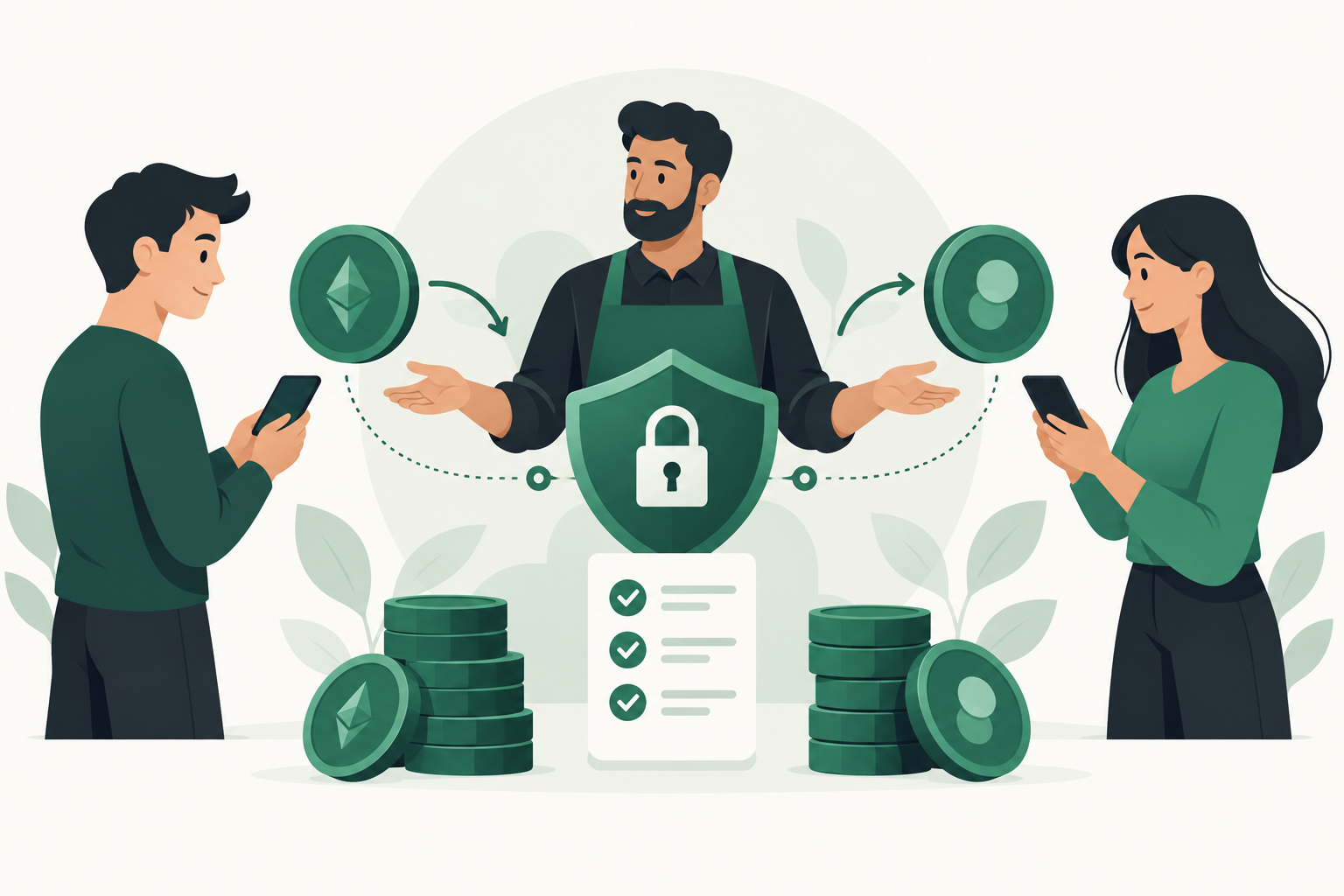
A P2P crypto merchant is someone who regularly buys or sells cryptocurrency directly with other people through a peer-to-peer marketplace, usually by posting offers with specific prices, payment methods, and trade limits. Merchants make crypto available to buyers or provide a way for sellers to cash out. They typically aim to earn a margin between their buying and selling prices, but fees, payment risks, and price changes can reduce or eliminate that margin.
You do not necessarily need a special account or a large operation to act as a merchant. What distinguishes the role is the ongoing work: maintaining offers, managing funds, checking payments, and helping trades finish correctly.
What does a P2P crypto merchant actually do?
A merchant brings together crypto inventory, access to payment methods, and availability. Someone who wants crypto can choose a sell offer; someone who wants to exchange crypto for local currency can choose a buy offer.
The merchant sets terms, while the other trader decides whether those terms suit them. Typical offer details include:
- The cryptocurrency being bought or sold.
- The price and local currency used for payment.
- The accepted payment method.
- The minimum and maximum trade size.
- Clear instructions for completing payment.
Once a trade begins, the merchant must respond promptly and follow the marketplace’s process. This is closer to running a small trading operation than simply holding crypto and waiting for its price to rise.
Merchant, trader, and payment processor: the difference
An occasional trader might buy crypto for personal use or sell an existing holding. A merchant repeatedly makes offers available and manages the practical work of fulfilling them. The same person can be a buyer in one transaction and a seller in another.
A P2P merchant is also different from a shop accepting crypto at checkout. Here, the transaction is an exchange of crypto for payment—not the purchase of goods from that shop.
“Merchant” does not automatically mean licensed, professionally vetted, or guaranteed safe. Formal status varies by platform and jurisdiction, so check the actual requirements rather than relying on the label.
How P2P trading and escrow work
In a P2P trade, the buyer pays the seller using the agreed payment method. The marketplace provides the trading environment and escrow rather than acting as the seller in every transaction.
VouchEx is a peer-to-peer marketplace for USDT on TRC-20 and Bitcoin. Every trade is protected by escrow: the seller’s crypto is locked until they confirm they received payment.
The basic sequence is:
- A buyer and seller enter a trade under an offer’s terms.
- The seller’s crypto is locked in escrow.
- The buyer sends payment through the agreed method.
- The seller checks their payment account and confirms receipt before releasing the crypto.
Escrow protects the crypto side of the exchange; it does not make every payment irreversible. A payment screenshot can be fabricated, and some payment methods permit reversals or disputes. Sellers still need to verify payment carefully.
You can browse the VouchEx marketplace to understand how available offers compare before deciding what kind of merchant activity would suit you.
How merchants earn money—and where the margin goes
A merchant typically aims to sell crypto for more than it cost to acquire. That difference is the gross trading margin, not take-home profit.
A useful planning formula is:
Net trading result = sale proceeds − acquisition cost − trading fees − payment and currency-conversion costs − applicable withdrawal costs.
Losses from reversals, errors, or price movements also affect the result. Your time matters too: an offer that requires constant manual checking may be less worthwhile than its headline margin suggests.
Understand the VouchEx fee structure
VouchEx charges:
- Buyer fee: 1% per completed trade.
- Seller fee: 1% per completed trade.
- Deposits: free.
- USDT withdrawals: $2.
- Bitcoin withdrawals: $5, paid in BTC.
- Offer posting: free, with no merchant deposit.
If you acquire crypto as a buyer and later sell it, account for the fees on both completed trades. Do not evaluate the sale in isolation.
“No merchant deposit” means there is no separate deposit required to become a merchant. It does not mean you can operate without funds: sellers need crypto, and buyers need money to pay their counterparties.
Price and liquidity risks still exist
Bitcoin’s price can move while you hold inventory. USDT is designed to track the US dollar, but it is not risk-free, and its local-currency value can change with exchange rates and market conditions.
Liquidity matters as well. Funds committed to one trade cannot necessarily support another. Avoid committing all your available capital or promising trade sizes you cannot fulfill.
How to start as a P2P crypto merchant: step by step
1. Choose a narrow starting scope
Start with a cryptocurrency, local currency, and payment method you understand. Consider how quickly you can verify payments and whether your payment provider permits the intended activity.
VouchEx supports hundreds of payment methods, including UPI, IMPS, bank transfer, PayPal, mobile money, and gift cards, across many local currencies. Availability does not mean every method has the same risk or evidence requirements.
Gift cards, for example, require different checks from bank transfers. Do not treat unfamiliar methods as interchangeable simply because their offers look attractive.
2. Check legal and account requirements
Regular buying and selling may create tax, recordkeeping, registration, or other obligations depending on where you operate and what you do. Marketplace access is not proof that your activity meets local requirements.
Review your bank or payment provider’s terms too. If you are unsure about operating commercially, obtain qualified local advice before committing funds.
3. Secure your account and prepare funds
Use a unique password and secure the email account connected to your marketplace account. VouchEx offers optional authenticator-app 2FA to protect withdrawals and releases; enable it before trading.
ID verification is available for verified badges. Treat a badge as an identity signal, not a guarantee of payment or good conduct.
When preparing crypto deposits or withdrawals, verify the asset, address, and network. VouchEx supports USDT on TRC-20; do not assume a USDT address on another network is compatible.
4. Write clear, workable offers
Anyone can post buy or sell offers on VouchEx for free. Your terms should make the next action obvious, not bury important conditions in vague language.
Specify the payment method, currency, trade limits, and payment instructions. Avoid requesting unnecessary personal information or introducing surprise conditions after someone starts a trade.
Set limits you can honor and publish offers only when you can respond. The merchant page is a useful starting point for exploring the merchant route on VouchEx.
5. Follow the payment timeline carefully
On VouchEx, buyers have a 15-minute payment window. Buyers should check payment details before sending funds and retain the transaction record.
Sellers should inspect their own bank or payment account—not just a screenshot, email, or message supplied by the buyer. Check the amount, currency, payment status, and relevant sender details.
Do not release crypto because someone pressures you or claims a payment will arrive later. If payment is pending or something does not match, consult the platform’s guidance rather than improvising.
6. Keep records and review completed trades
Record the trade reference, amounts, fees, payment reference, and outcome. Keep sensitive records secure and retain only what is necessary for legitimate operational and legal purposes.
After each trade, compare the actual result with your expected margin. Review delays and confusing instructions as well as financial performance. Increase your activity only when your process is reliable.
Handling problems without making them worse
The most expensive mistakes often happen when a trader rushes to “fix” an unusual payment.
Watch for:
- Requests to release crypto before payment is verified.
- Screenshots that conflict with your actual account balance or transaction history.
- Unexpected third-party payments or mismatched payer details.
- Requests to move the transaction outside the marketplace.
- Overpayments followed by instructions to refund a different account.
Keep trade-related communication in the marketplace where possible. If an unexpected payment arrives, do not send a refund to newly supplied details without checking the proper process with the platform and payment provider.
On VouchEx, disputes can be opened 3 hours after a trade starts. The person opening the dispute pays 1% of the trade, and moderators aim to resolve disputes within 2 hours. That resolution time is an aim, not a guarantee.
The dispute-opening threshold is separate from the buyer’s payment window; it does not extend the time allowed to pay. Preserve relevant evidence and use the help section for guidance when something goes wrong.
Is merchant trading right for you?
Merchant activity may suit someone who can maintain funds, respond consistently, verify payments, and keep accurate records. It is less suitable if you need guaranteed returns or cannot monitor active trades.
Start by assessing your operational readiness, not just possible profit. A repeatable process with clear limits is more valuable than an attractive price you cannot safely deliver.
FAQ
What is a P2P crypto merchant in simple terms?
A P2P crypto merchant regularly offers to buy or sell cryptocurrency directly with other users. They manage prices, payment methods, available funds, and trade fulfillment, usually aiming to earn a margin.
Do I need a merchant deposit on VouchEx?
No. Anyone can post buy or sell offers for free, and there is no merchant deposit. You still need the crypto or payment funds required for your trades, and completed-trade fees apply.
Is a verified merchant guaranteed to be safe?
No. VouchEx offers ID verification for verified badges, but identity verification does not guarantee honest behavior or prevent payment reversals. Continue using escrow, checking payments, and following the trade process.
Can a P2P merchant lose money?
Yes. Trading fees, payment-provider charges, currency conversion, price changes, reversals, and operational mistakes can outweigh the gross margin. Merchant trading is not guaranteed income.
Does escrow remove the need to check payment?
No. Escrow locks the seller’s crypto, but the seller must still confirm receipt in their own payment account. A buyer’s screenshot or message is not sufficient proof, and receipt does not necessarily eliminate reversal risk.
Start Trading on VouchEx with 0% Listing Fees
Explore the open P2P software protocol.