
p2p trading tips for beginners: Start With a Safer Plan
Your first P2P trade should be easy to understand, not just attractively priced. Learn how to compare offers, budget for fees, verify payments, and handle problems without rushing.
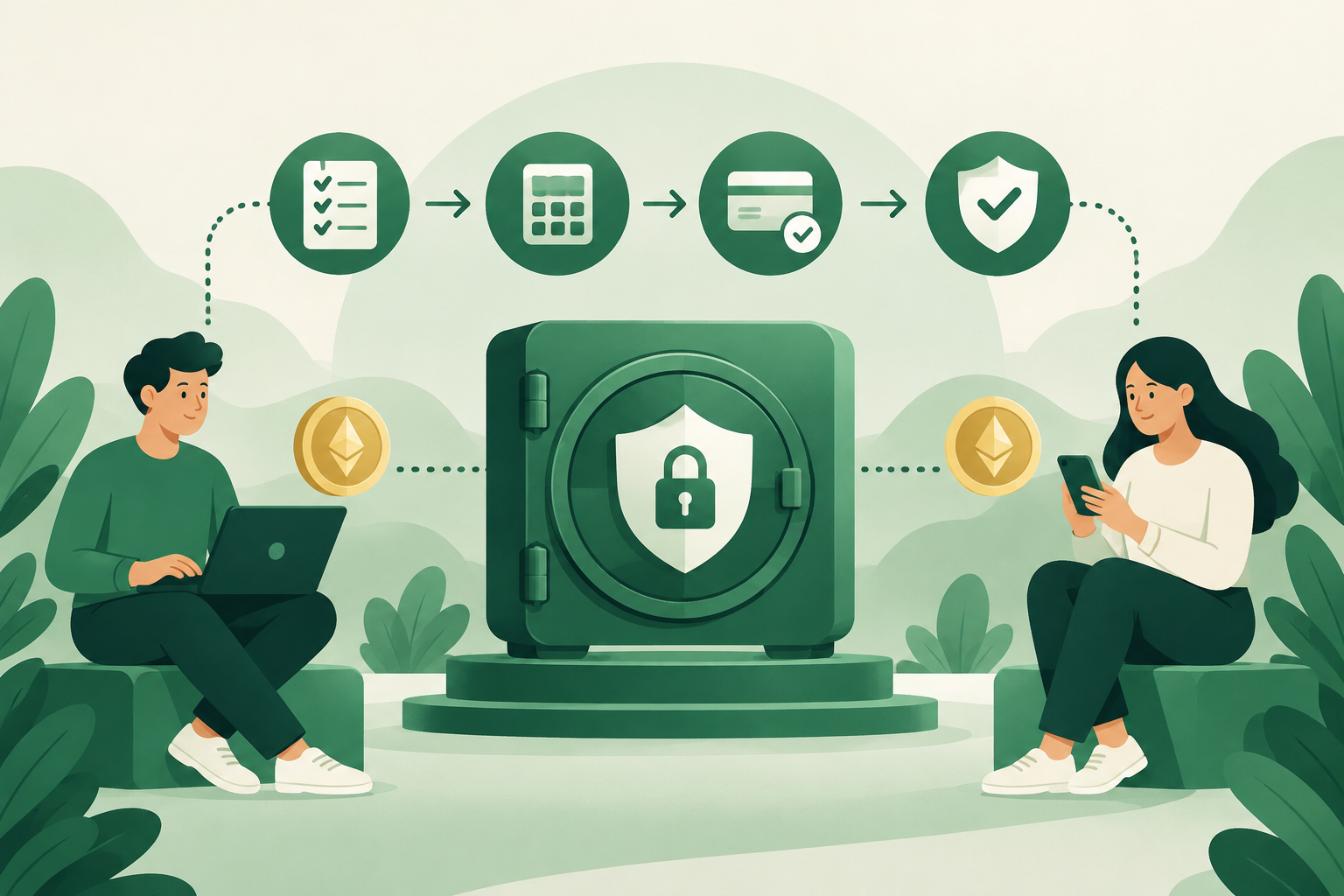
The most useful p2p trading tips for beginners are to start with an amount you can afford to have temporarily tied up, choose a payment method you understand, compare the total cost, and keep the transaction protected by escrow. Buyers should pay only after confirming the seller’s crypto is locked; sellers should release crypto only after independently verifying payment. A good first trade is one you can explain and document—not simply the cheapest offer you find.
Understand what you are agreeing to
Peer-to-peer trading means buying cryptocurrency from, or selling it to, another person through a marketplace. The offer sets the commercial terms, including the asset, price, payment method, currency, and transaction limits.
VouchEx is a P2P marketplace for USDT on the TRC-20 network and Bitcoin. Every trade is protected by escrow: the seller’s crypto is locked until they confirm they received payment.
That protection matters, but it has boundaries. Escrow holds the crypto; it does not make every payment genuine, prevent every payment reversal, or guarantee that someone will follow the terms.
Keep these roles separate:
- The marketplace provides the trading environment and escrow.
- The payment provider handles the local-currency payment under its own rules.
- You must check the offer, follow the instructions, and verify the relevant transaction.
Buying crypto through P2P also does not remove asset risk. Bitcoin’s value can fluctuate substantially, and USDT carries stablecoin-related risks. A smooth purchase is not a guarantee about future value.
Compare offers by fit before price
An attractive exchange rate is only useful if you can meet the offer’s conditions safely. Before starting, review the following.
Payment method and currency
Choose a method you already know how to use and verify. VouchEx supports hundreds of payment methods, including UPI, IMPS, bank transfer, PayPal, mobile money, and gift cards, in many local currencies.
Availability does not mean every method has the same risk. Transfers may be delayed or reviewed; some payments can be challenged or reversed. Gift cards involve different evidence and redemption risks from bank payments.
For a first trade, familiarity is usually more valuable than an unusual method with a better advertised rate. Check your payment provider’s rules and any applicable local requirements before proceeding.
Offer terms and counterparty signals
Read the entire offer. Confirm that your intended amount fits its limits and that you can provide any legitimate payment evidence requested without exposing unnecessary personal information.
Review any available trading history, feedback, and identity signals. VouchEx offers verified badges through ID verification, but a verified badge is not a guarantee of honest behavior.
Skip an offer if its terms are unclear, contradictory, or dependent on an arrangement outside the marketplace. You do not need to negotiate your way into a confusing first trade.
Calculate the real cost before committing
The advertised rate is not necessarily your final cost. On VouchEx:
- Buyers pay 1% per completed trade.
- Sellers pay 1% per completed trade.
- Deposits are free.
- USDT withdrawals cost $2.
- Bitcoin withdrawals cost $5, charged in BTC.
The buyer’s and seller’s fees apply to their respective sides; do not assume you personally pay both. Check the amounts shown before confirming rather than guessing how fees affect your balance.
Your payment provider may also charge a transfer or currency-conversion fee. Include those costs when comparing offers.
For a buyer, the useful comparison is:
Total money spent ÷ crypto ultimately received at the intended destination.
For a seller, compare the money actually retained with the total crypto spent, accounting for applicable fees.
A small first trade limits exposure, but a fixed withdrawal fee can represent a larger share of a small amount. Choose a manageable trade size with that trade-off in mind—not an amount so small that the fee picture becomes misleading.
Your first P2P trade: a practical step-by-step plan
Step 1: Prepare your account and payment access
Use a unique password and enable authenticator-app two-factor authentication. On VouchEx, optional 2FA protects withdrawals and releases. It is worth enabling before you have funds at risk.
Check that you can access your payment account, have sufficient funds if buying, and understand any transfer limits. Never share passwords, authenticator codes, or wallet recovery phrases with a counterparty or someone claiming to provide support.
You can create a VouchEx account before selecting an offer, so account preparation does not consume your payment time.
Step 2: Define the trade you actually need
Decide whether you are buying or selling, which asset you want, the local currency, and the payment method.
If you intend to withdraw afterward, confirm that the receiving wallet supports the asset and network. VouchEx supports USDT on TRC-20; another USDT network is not interchangeable merely because the token has the same name.
Check the withdrawal address carefully. Do not rely only on a familiar label or the beginning of an address.
Step 3: Read and compare suitable offers
Browse the VouchEx marketplace and compare offers that meet your requirements. Evaluate the rate alongside fees, terms, and available counterparty information.
Do not start a trade while still deciding how you will pay. Your preparation should be complete before the payment window begins.
If you choose to post your own offer instead, VouchEx allows anyone to post buy or sell offers for free, with no merchant deposit. That does not remove the trading fees or your responsibility to set clear terms.
Step 4: Confirm escrow and follow the agreed instructions
Before sending money as a buyer, confirm within the marketplace that the trade is active and the seller’s crypto is held in escrow.
VouchEx buyers have a 15-minute payment window. Verify the recipient details, amount, and payment method before authorizing the transfer. Follow the platform’s instructions for recording that payment was sent, and keep the receipt.
Do not accept a request to bypass escrow or send an additional payment to “unlock” the crypto. If recipient details change unexpectedly, pause and seek clarification through the platform before paying.
Step 5: Verify the correct event before proceeding
If you are buying, a completed payment instruction is not necessarily proof that the seller has received usable funds. Preserve the transfer status and reference so you can explain what happened if there is a delay.
If you are selling, open your bank or payment app independently. Confirm the amount, currency, sender information, and actual payment status against the trade.
A screenshot, email, or urgent message is not a substitute for checking your own account. Do not release against a pending payment or a promise that it will arrive later. Where payments can be reversed, understand that risk even after funds appear.
Step 6: Close the loop and save your records
After completion, keep the trade details and payment reference. If withdrawing, recheck the asset, network, address, and displayed fee before confirming.
Review your first trade afterward: Was the total cost what you expected? Were the terms clear? Did the payment method create unnecessary uncertainty? Use those answers to improve your next trade rather than immediately increasing its size.
What to do when something goes wrong
The most expensive beginner mistake is often trying to solve uncertainty by sending more money or releasing crypto too early.
If payment is delayed, details do not match, or the counterparty pressures you:
- Keep communication and evidence tied to the platform trade.
- Record the trade identifier, payment reference, amount, and relevant timestamps.
- Save relevant messages and payment-status evidence.
- Do not make a second payment simply because the first is disputed or delayed.
- If you already paid, seek guidance before accepting a request to cancel.
- As a seller, do not release crypto while receipt of payment remains unverified.
On VouchEx, disputes can be opened 3 hours after a trade starts. The person opening the dispute pays 1% of the trade. Moderators aim to resolve disputes within 2 hours, but that is a target, not a guaranteed deadline.
The 15-minute payment window and the 3-hour dispute threshold are different rules. Do not treat the later dispute threshold as extra time to pay.
Use the VouchEx help section for guidance. Present a short factual timeline and supporting evidence, not accusations. Share sensitive financial information only through appropriate support channels, and exclude unrelated private details where possible.
FAQ
What are the most important P2P trading tips for beginners?
Use escrow, read the complete offer, calculate all applicable costs, and choose a payment method you understand. Buyers should confirm escrow before paying; sellers should independently verify payment before releasing crypto. Start with manageable exposure and keep records.
Does escrow make P2P trading completely safe?
No. Escrow protects the crypto while the trade is underway, but it cannot eliminate payment fraud, reversals, account compromise, or mistakes. It works best alongside careful payment verification and secure account access.
How much should I use for my first trade?
There is no universal amount. Choose an amount you can afford to have temporarily unavailable, while considering offer limits, trading fees, and any planned withdrawal fee. The first trade should test your understanding of the process, not maximize your volume.
What if I cannot pay within the 15-minute window?
Do not start until you are ready to pay. If a problem arises after starting, follow the platform’s instructions and seek help. If you already sent money, preserve the receipt and clearly document the status rather than paying again or assuming cancellation will recover the payment.
Should a seller release crypto after receiving a payment screenshot?
No. Check the payment directly in your own bank or payment account. Match it to the trade and verify that it is not merely pending. A screenshot can support a conversation, but it cannot establish that you received the agreed funds.
Start Trading on VouchEx with 0% Listing Fees
Explore the open P2P software protocol.