
p2p crypto tds india who deducts: A Practical Guide
In a direct P2P crypto purchase from a resident Indian seller, the buyer generally handles applicable TDS. Here’s how to check responsibility, agree on payment amounts, and keep the right records.
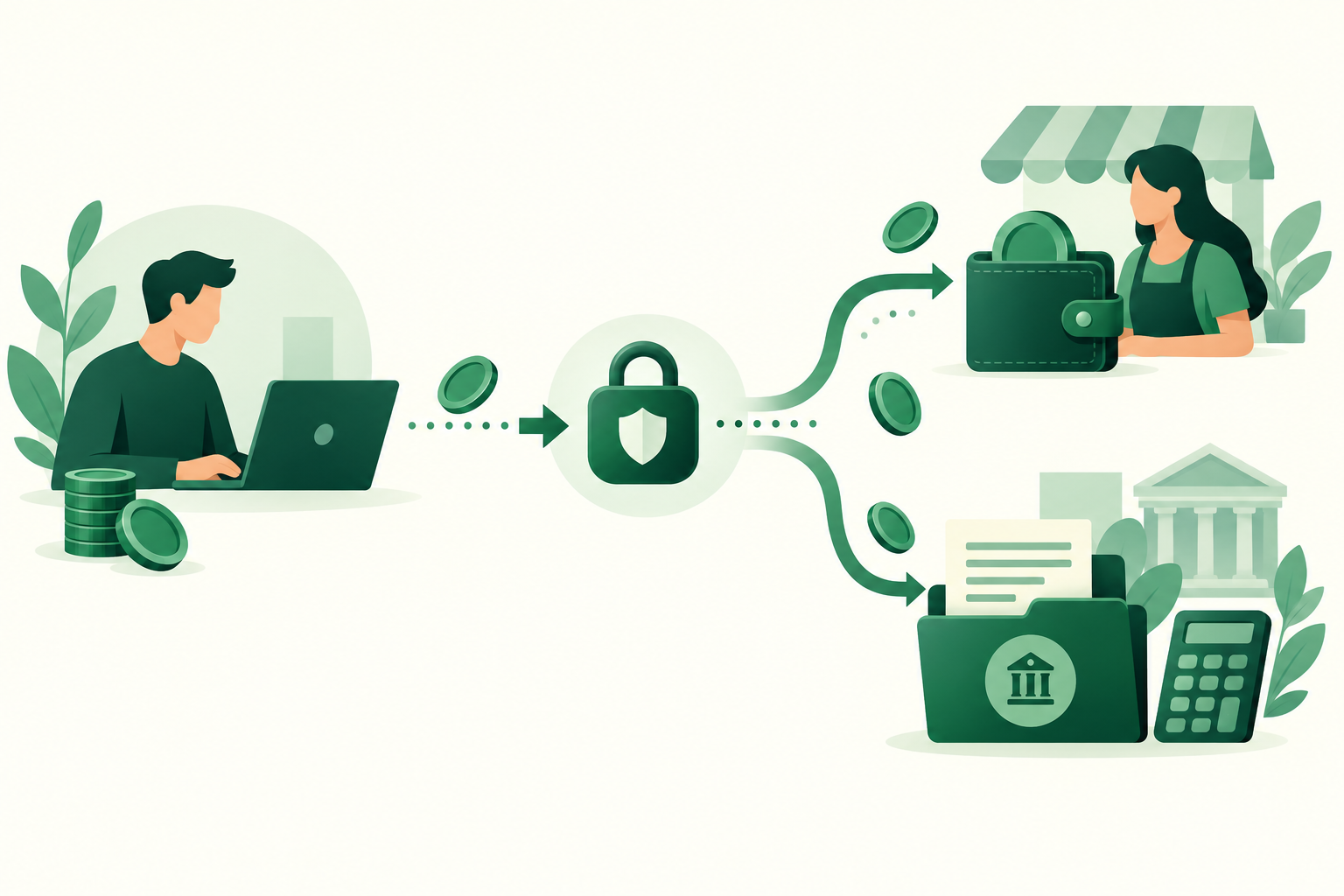
In India, the buyer generally deducts and deposits 1% TDS when buying crypto directly from a resident seller, if Section 194S applies and its annual threshold is exceeded. Using a P2P marketplace does not automatically make the platform responsible. An exchange may handle withholding under applicable CBDT arrangements, but you need confirmation—not an assumption based on escrow or trading fees.
That is the practical answer to “p2p crypto tds india who deducts.” The next question is how to handle it without underpaying your seller, missing a tax filing, or paying TDS twice.
This guide explains the Section 194S framework. It is general information, not personalised tax advice; check current official guidance and filing requirements before transacting.
Who is responsible: buyer, seller, or platform?
Direct buyer-to-seller payment
Suppose you buy USDT or Bitcoin and send rupees directly to the seller’s bank account. If the seller is resident in India for tax purposes and the transaction falls within Section 194S, you, as the buyer, generally have the withholding obligation.
The seller receives the agreed consideration after applicable withholding and can claim the deposited TDS as tax credit, subject to correct reporting and reconciliation.
An individual buying crypto for personal investment is not automatically exempt. Neither is a small trader simply because they do not operate a registered business.
A marketplace or exchange handles the deduction
CBDT guidance provides mechanisms for exchanges to handle TDS in qualifying arrangements. Responsibility depends on the transaction structure, the parties involved, and any required agreement—not merely on whether a website calls itself an exchange.
Before paying, ask:
- Does the platform deduct and deposit Indian TDS for this transaction?
- Under whose PAN will the deduction be reported?
- Will you receive documentation showing the gross consideration and TDS?
- Is any action still required from you?
A trading fee is not proof of TDS compliance. A platform charging 1% does not mean it has withheld the separate 1% tax.
The seller is non-resident
Section 194S concerns payments to resident sellers. A payment to a non-resident can require a different withholding analysis, including Section 195 where applicable.
Do not infer tax residency from an Indian bank account, UPI address, phone number, or nationality. If residency is unclear, resolve it before paying rather than assuming there is no withholding obligation.
When does the 1% TDS apply?
Under Section 194S, deduction is generally triggered at credit or payment, whichever is earlier. It is based on the consideration for the crypto transfer, not the seller’s profit.
The annual exemption thresholds are:
- ₹50,000 when the payer is a “specified person.”
- ₹10,000 for other payers.
A specified person is broadly an individual or Hindu undivided family who either:
- Has no income under the head “Profits and gains of business or profession”; or
- Has business turnover not exceeding ₹1 crore, or professional gross receipts not exceeding ₹50 lakh, in the financial year immediately preceding the year of transfer.
These are statutory classification limits, not marketplace account tiers. Someone casually described as a “merchant” may still need a separate tax classification check.
The thresholds are annual, not per order. Splitting a purchase into smaller trades does not reset them. If your activity crosses a threshold during the year, confirm how the crossing transaction and earlier payments must be treated; do not assume only the amount above the threshold is subject to TDS.
For source material, consult CBDT’s Circular No. 13 of 2022 and Circular No. 14 of 2022, alongside any subsequent updates. These address exchange arrangements and transactions outside exchanges.
A simple example: what reaches the seller?
Assume all of the following:
- You are buying crypto directly from a resident seller.
- TDS applies, with no higher-rate issue.
- The agreed crypto consideration is ₹100,000.
- This illustration excludes platform fees and other charges.
The basic calculation is:
- Gross crypto consideration: ₹100,000
- TDS at 1%: ₹1,000
- Payment to seller: ₹99,000
- Amount deposited as TDS: ₹1,000
Your obligation is not complete when you retain ₹1,000. You must deposit and report it correctly against the seller’s details.
For the seller, the withheld amount is a tax credit, not a discount given to the buyer. For the buyer, it is not money saved.
The example assumes a gross-price agreement. If the seller demands a fixed amount “in hand,” clarify the tax calculation and contractual price before opening the trade. Do not improvise a gross-up during a payment countdown.
Step by step: handle TDS before starting a P2P trade
1. Establish the parties and the applicable threshold
Check the seller’s tax residency and your payer classification. Review your financial-year transaction records rather than considering only today’s purchase.
If you trade regularly, use a ledger containing transaction dates, counterparties, gross consideration, fees, and tax deductions. Ask a chartered accountant how the annual threshold applies to your particular transaction history.
2. Confirm who will deduct and report
Get a clear answer before sending money. If a platform says it handles TDS, establish whether that statement covers your particular P2P payment route.
If the seller says they will “pay their own tax later,” that does not by itself remove a buyer’s withholding duty.
Likewise, a seller should not accept an unexplained deduction merely because the buyer labels it TDS.
3. Obtain the required details securely
Buyer-side filing requires accurate identifying information, including the seller’s PAN. Missing or invalid PAN can affect the applicable withholding rate and prevent clean reporting.
Use a suitable private channel for necessary tax details. Do not post PAN information in a public offer, and never share OTPs, account passwords, or recovery codes to “verify TDS.”
If the parties cannot exchange the required information safely, do not start the trade.
4. Agree on gross price, TDS, and net payment
Record the gross consideration, applicable deduction, net bank payment, and separate fees in writing. Keep the agreement within the trade record wherever possible.
Confirm that the marketplace’s order and payment process supports the arrangement. A tax calculation does not authorise you to ignore the displayed payment requirement or unilaterally short-pay an order.
5. Pay and preserve evidence
Send the agreed net amount using the agreed payment method. Save the payment reference, trade ID, calculation, and communication confirming the arrangement.
Sellers should verify the actual bank credit rather than relying on a screenshot. Release should follow the agreed payment terms, including the documented withholding—not an unexpected claim made after payment.
6. Deposit, file, and provide the certificate
For a specified person using the Section 194S process, Form 26QE is the challan-cum-statement. It is generally due within 30 days from the end of the month in which deduction occurs. This route does not require a TAN.
The associated Form 16E certificate is generally due within 15 days from the due date for Form 26QE.
Other deductors generally use the regular TAN-based TDS process, including Form 26Q and the applicable certificate and deposit deadlines. Do not apply the 26QE timetable to every buyer.
Verify the current process on the Income Tax Department portal. If you have already paid without required withholding, obtain advice promptly rather than treating a later deduction on an unrelated trade as a fix.
What to check when using VouchEx
VouchEx is a P2P marketplace for USDT on TRC-20 and Bitcoin. Every trade uses escrow: the seller’s crypto stays locked until they confirm receipt of payment.
Escrow protects the trade process; it does not establish who handles Indian TDS. The product facts described here do not establish that VouchEx deducts or deposits Section 194S tax. Confirm the applicable workflow through VouchEx help before placing an order that requires withholding.
VouchEx charges the buyer and seller 1% each per completed trade. These service fees must be kept separate from your TDS calculation. Do not assume either fee is a tax remittance or automatically subtract it from the withholding base.
Buyers have a 15-minute payment window, so tax residency, PAN details, and net-payment agreement should be settled before the countdown starts. When reviewing marketplace offers, look beyond the quoted rate: an offer is not operationally suitable if the parties cannot agree on compliant payment handling.
The India USDT buying guide can help with the broader purchase checklist; tax documentation remains a separate task.
Records that prevent problems later
Keep one folder or ledger entry per trade containing:
- The trade confirmation and gross consideration.
- Separate platform fees and other charges.
- Bank payment reference and agreed net payment.
- Relevant seller details, stored securely.
- TDS calculation, deposit acknowledgement, and filing record.
- The applicable TDS certificate.
As a seller, reconcile the deduction against your tax records, including Form 26AS and AIS where reflected. If credit is missing or attributed incorrectly, ask the deductor to investigate and correct the filing.
TDS is a collection mechanism, not your final crypto tax calculation. A profitable sale, a loss-making sale, and a purchase can create different reporting consequences even when withholding appears similar.
FAQ
Does the buyer or seller deduct TDS on P2P crypto in India?
For a direct purchase from a resident seller, the buyer generally deducts applicable Section 194S TDS. Qualifying exchange arrangements can change who performs the deduction, so confirm the actual transaction structure.
Is TDS charged on profit or the full trade value?
It is generally based on transfer consideration, not profit. A seller making a loss does not automatically make the payment exempt from TDS. Treatment of separately charged fees needs its own check.
Does paying through UPI remove the TDS requirement?
No. UPI, IMPS, and bank transfer are payment methods, not tax exemptions. The parties, residency, applicable threshold, and transaction structure determine withholding obligations.
What if the seller refuses a TDS deduction?
Do not force a short payment or agree to skip required withholding. Resolve the gross price, net payment, documentation, and platform workflow before trading. Choose another offer if a compliant arrangement is not possible.
Do crypto-for-crypto trades avoid TDS?
Not necessarily. Section 194S includes provisions for consideration in kind, and a crypto swap can create obligations on both sides. Tax payment must be addressed before consideration is released; get transaction-specific advice rather than applying the rupee-payment example unchanged.
Start Trading on VouchEx with 0% Listing Fees
Explore the open P2P software protocol.