
p2p crypto buyer paid from another bank eft pending south africa
An EFT confirmation is not the same as money received. Here’s how South African P2P buyers and sellers can handle an interbank delay without risking a premature crypto release or duplicate payment.
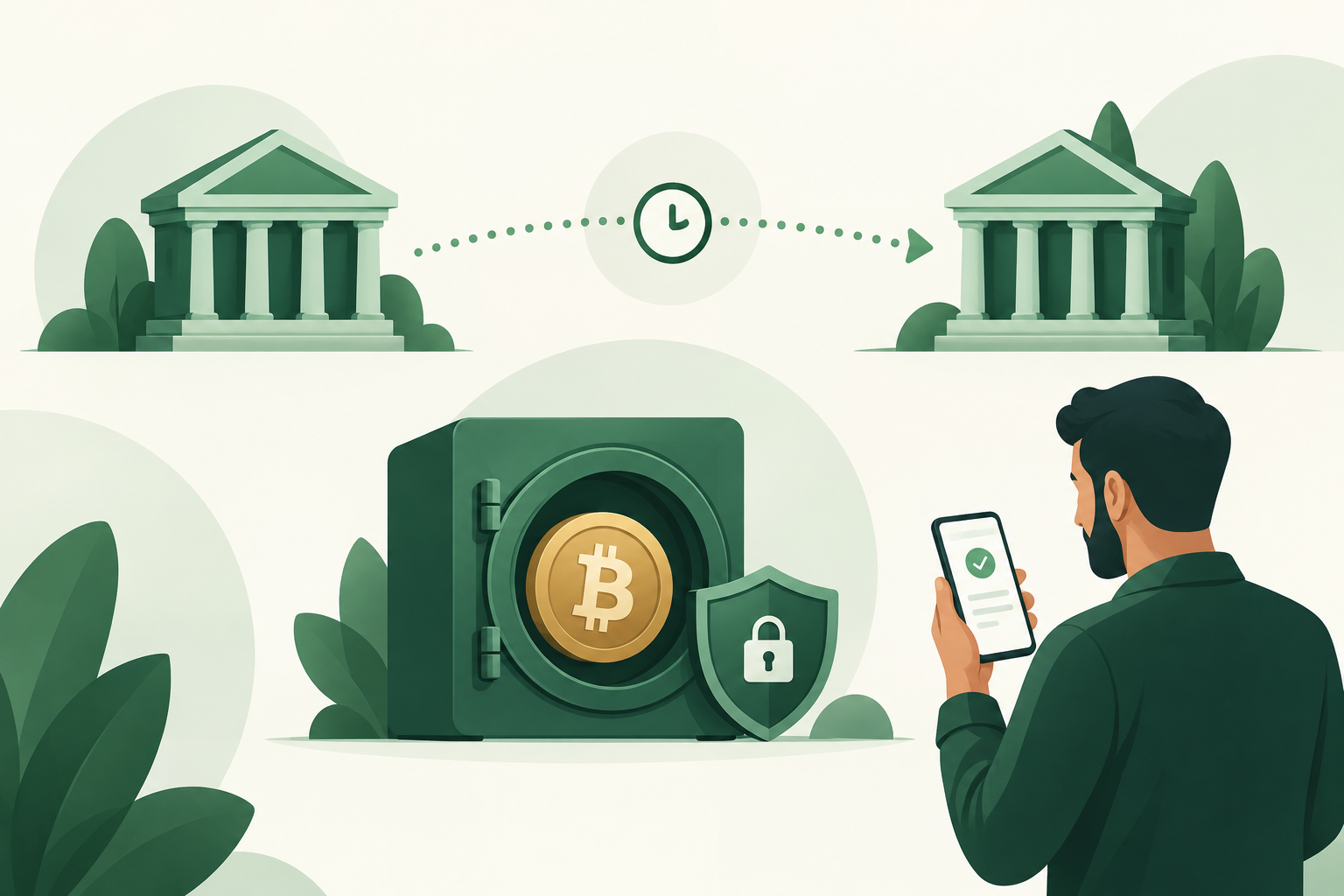
If a P2P crypto buyer paid from another bank and the EFT is still pending in South Africa, the seller should not release crypto until the payment is credited and available in their own bank account. The buyer should keep the bank reference, check the transfer’s actual status, and explain the delay through the marketplace’s trade communication channel. A proof-of-payment document helps trace an EFT; it does not establish that the seller received the money.
The immediate goal is to distinguish a normal interbank delay from a failed transfer, incorrect payment details, or a suspicious claim—without sending a second payment or releasing crypto prematurely.
Why an EFT can be pending after the buyer has paid
A buyer’s bank and a seller’s bank can show different stages of the same transfer. Money may appear debited on the sending side before it becomes available on the receiving side.
Possible reasons include:
- The buyer selected a standard EFT rather than an immediate-payment option.
- The payment was submitted outside the bank’s relevant processing times.
- A weekend or public holiday affects processing.
- The bank is conducting checks or experiencing a service interruption.
- The payment is scheduled, awaiting authorisation, or unsuccessful rather than completed.
- The beneficiary details were entered incorrectly.
Do not assign a universal arrival time to an interbank EFT. Ask the sending bank about the specific payment type and transaction status. The receiving bank can help the seller interpret an unfamiliar incoming entry or restriction.
Another bank is not necessarily another person’s account
These are separate issues. A buyer paying from their own account at a different bank creates an interbank timing question. A buyer paying from a friend’s, employer’s, or unrelated person’s account creates a payer-identity question.
If the payer name differs from the expected buyer, pause and seek platform guidance. A delayed EFT should not become an excuse to overlook an unexplained name mismatch.
What counts as payment confirmation?
The seller should verify receipt independently by opening their banking app or website through their usual trusted route. Do not use a login link supplied by the buyer.
Check the transaction entry, not just a notification or a change in the account’s total balance. Match the amount and reference, and review the payer information where the bank provides it.
Useful evidence, but not a reason to release
These can help investigate a transfer:
- A bank-generated proof of payment.
- A transaction reference or tracking identifier.
- The payment date, time, amount, and selected payment type.
- A screenshot showing the sender’s transaction status.
However, a document can be altered, a screenshot can be misleading, and a genuine payment instruction can still be pending. None substitutes for checking the receiving account.
The receiving account is the release checkpoint
Before releasing, establish that the correct payment is credited and available, rather than merely displayed as pending. If the entry is unclear, ask the bank what it means.
Even a credited payment is not a promise that no fraud investigation or banking restriction could ever follow. Payer checks and compliance with the trade terms still matter. If something looks suspicious, seek assistance before releasing.
Step by step: handle a pending EFT safely
1. Preserve the trade details
Keep a record of the trade identifier, agreed rand amount, beneficiary details, payment reference, offer terms, and relevant timestamps.
Keep payment-related communication within the marketplace’s trade communication channel where available. Moving to private messages makes it harder to preserve a complete record for review.
The seller should not release because the buyer is impatient. The buyer should not pay again merely because the first EFT has not arrived.
2. Confirm exactly what the buyer submitted
The buyer should inspect the transaction in their own banking app and establish:
- Was it a standard EFT or an immediate-payment option?
- Does it show pending, scheduled, failed, or completed?
- Were the account number, bank, amount, and reference correct?
- Was any further authorisation required?
Share relevant evidence through the appropriate trade or support channel. Mask unrelated balances and transactions, but leave the payment information needed for review visible. Never share passwords, PINs, or one-time codes.
3. Check the seller’s account independently
The seller should refresh their transaction history and look for a matching credit. An SMS, email, or buyer-supplied screenshot is not sufficient.
If several credits have the same amount, use the reference and available payer details to identify the correct one. Do not allocate an unrelated deposit to the trade just to make the totals fit.
If no matching payment appears, state that clearly. “Not received yet” describes the evidence; it does not automatically accuse the buyer of dishonesty.
4. Separate the payment deadline from settlement
On VouchEx, buyers have a 15-minute payment window. That is not a guarantee that an interbank EFT will reach the seller within 15 minutes.
VouchEx protects every trade with escrow: the seller’s crypto is locked until they confirm receipt of payment. However, do not assume what happens to a particular trade when its payment window expires. Check its current status and consult VouchEx help if a submitted payment remains pending.
If you have already sent money, do not cancel simply because the seller asks you to “start again.” First obtain guidance on how the existing payment and trade will be handled. Equally, never claim payment was sent when you only saved beneficiary details or prepared a transfer.
5. Trace the transfer rather than paying twice
The buyer should contact the sending bank using its official support route. Provide the reference and ask whether the payment was submitted, is being processed, failed, or needs action.
The seller can ask their bank about a visible pending credit or whether additional information would help investigate receipt. Neither party should promise a settlement time that the banks have not confirmed.
If the beneficiary details were wrong, tell the sending bank promptly. Recovery is a banking matter and should not be assumed possible.
6. Escalate an unresolved trade with organised evidence
On VouchEx, disputes can be opened 3 hours after a trade starts. The opener pays 1% of the trade, and moderators aim to resolve disputes within 2 hours. That is a resolution target, not a guarantee of bank settlement or a particular outcome.
Prepare a concise timeline with the trade identifier, payment reference, proof of payment, sending-bank status, relevant messages, and the seller’s evidence of non-receipt where requested.
If payment arrives while the dispute is being reviewed, update the moderator and follow the dispute instructions. Do not leave the case based on outdated information.
What to do in common situations
The buyer says the payment was immediate
Ask them to confirm the payment type in their banking record. “Immediate” is not a reason to ignore an absent credit. If the expected processing time has passed, the buyer should ask their bank to trace it.
The seller still verifies receipt independently before release.
The seller is asked to refund to another account
Do not send a supposed refund before confirming that the original money arrived. A request to refund to an unrelated account is an additional warning sign.
If a duplicate or late payment genuinely arrives, contact the platform and bank for guidance on a documented return. Do not improvise a separate payment route under pressure.
The trade closes before the EFT arrives
Preserve the original trade record and contact support promptly. Do not assume a new trade automatically covers the old payment, or that the original escrow remains active.
If the money later arrives, report it so the parties and support can reconcile the payment without duplicate transfers or releases.
Prevent the same problem on your next trade
Before choosing an offer, agree on the accepted bank-transfer method and read the payment terms. If timing is critical, check whether the proposed transfer type suits those terms before starting—not after sending money.
VouchEx is a peer-to-peer marketplace for USDT on TRC-20 and Bitcoin. When reviewing marketplace offers, compare payment requirements as well as price. A favourable rate does not make an unsuitable payment method a good choice.
VouchEx charges buyers and sellers 1% each per completed trade. Keep that separate from any bank transfer charges and the dispute-opening fee described above.
For sellers, optional authenticator-app 2FA protects releases and withdrawals. It adds account security, but it cannot determine whether an EFT arrived. The central rule remains: verify the payment before authorising the crypto release.
FAQ
Should I release crypto if the buyer sends proof of payment?
No. Use the proof to help identify or trace the transfer. Release only after independently verifying the correct payment is credited and available in your account, with no unresolved payment concern.
How long does an EFT from another South African bank take?
There is no single reliable answer for every transfer. Timing depends on the banks, payment type, submission time, processing schedules, and possible checks or interruptions. Ask the sending bank about the specific transaction rather than relying on a generic estimate.
What if I paid within 15 minutes but the seller has not received it?
Keep evidence of when you submitted payment, check its status with your bank, and tell the seller. VouchEx’s payment window does not guarantee interbank settlement within that period. Check the trade status and request platform guidance if it remains unresolved.
Can I open a VouchEx dispute immediately?
Disputes can be opened 3 hours after the trade starts. The opener pays 1% of the trade, and moderators aim to resolve disputes within 2 hours. Meanwhile, preserve evidence and use the help channel for guidance without assuming early dispute access.
Should the buyer send another EFT to speed things up?
No—not while the first payment’s status is unresolved. A second transfer can create a duplicate payment without fixing the original delay. Trace the first EFT and establish how it and the trade will be handled before making another payment.
Start Trading on VouchEx with 0% Listing Fees
Explore the open P2P software protocol.