
Is P2P Crypto Trading Legal in Ghana? Rules to Check
P2P crypto trading in Ghana requires more than finding a willing buyer or seller. Learn how to check the applicable rules, distinguish personal trading from a business, and protect your payment records.
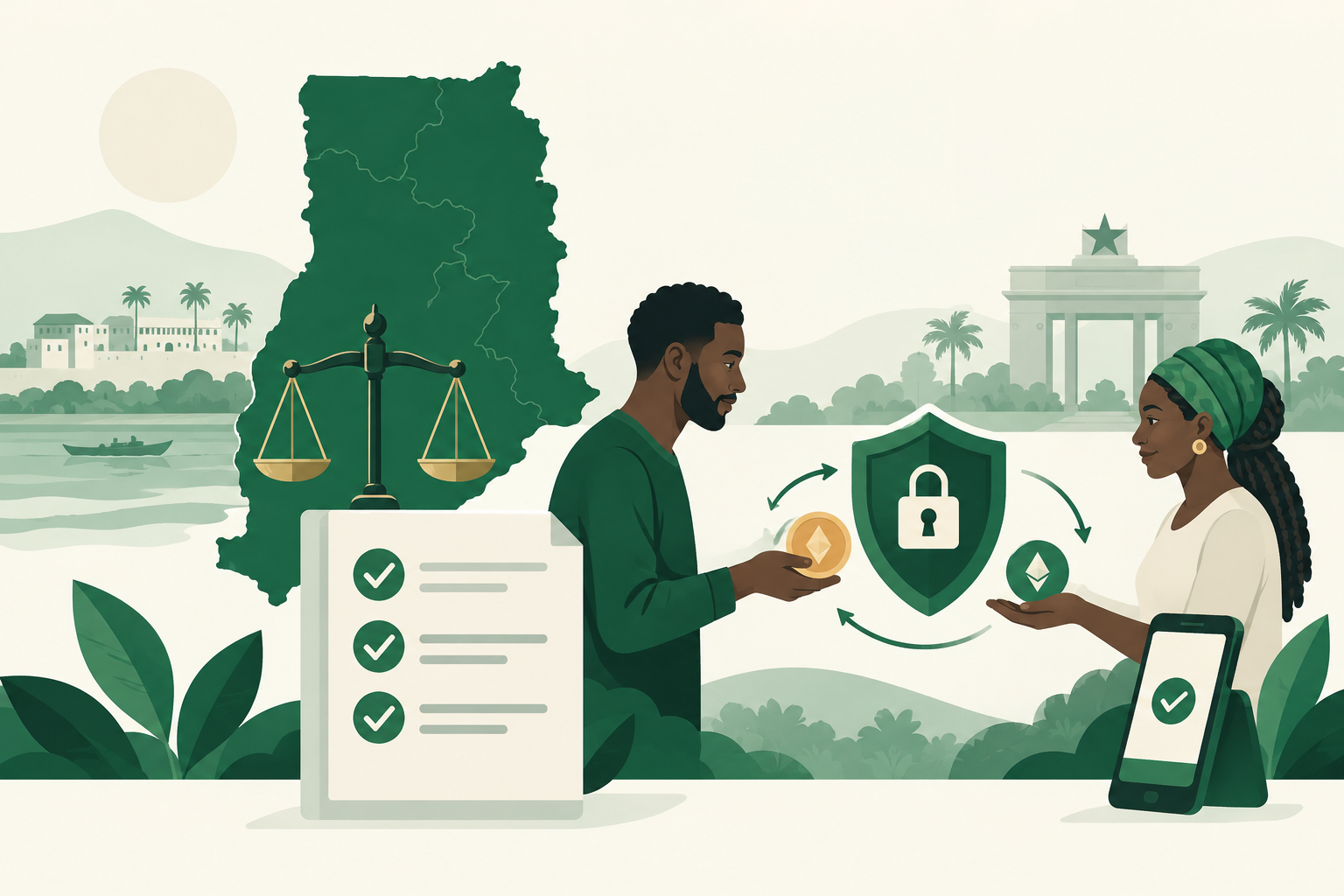
P2P crypto trading in Ghana can be lawful, but it is not automatically permitted in every form. The answer depends on your activity, the service you use, and the rules currently in force. Buying or selling your own crypto is different from operating a trading service, and Bitcoin and USDT are not Ghanaian legal tender. Before trading, check the applicable regulatory requirements and your payment provider’s terms.
Important limitation: This guide is not a live verification of Ghana’s latest legislation or any platform’s licensing status. It provides a practical checking process, not a blanket legal clearance or personalised legal advice.
What “legal” means for a P2P crypto trade
A peer-to-peer trade involves buying or selling crypto directly with another person, often through a marketplace that coordinates the transaction. The buyer sends money using an agreed payment method, and the seller transfers the crypto.
Several separate questions determine whether that transaction is appropriate:
- Your activity: Are you trading your own assets or providing a service to other people?
- The platform: Can it lawfully offer the relevant service to Ghanaian users?
- The payment method: Does your bank or mobile money provider permit that use of your account?
- The funds: Can you explain their source and the purpose of the transaction?
- Reporting: Do you have tax, business-registration, or other obligations?
A platform accepting your registration does not answer all these questions. Neither does a successful mobile money transfer.
Not legal tender does not mean automatically illegal
Legal tender status and permission to trade an asset are different concepts. Bitcoin and USDT are not Ghanaian legal tender, but that fact alone does not establish that every private crypto purchase is a criminal offence.
The reverse assumption is also unsafe: an asset being tradable does not make every exchange, payment arrangement, or business model lawful. USDT is a cryptoasset, not a Ghanaian bank deposit, and its dollar reference does not make it official US currency.
Where to check Ghana’s current position
Use primary sources rather than old headlines, screenshots, or assurances from another trader.
Bank of Ghana
Check the Bank of Ghana’s official website for current virtual-asset notices, payment-sector guidance, and information about any applicable authorisation arrangements.
Pay attention to the document’s status. A consultation, proposed framework, registration exercise, enacted law, and operating licence are not interchangeable. Read the effective date and any transitional provisions, not just the headline.
Securities and Exchange Commission Ghana
Consult the Securities and Exchange Commission Ghana where an activity involves investments, managing money for others, or products marketed with returns.
A straightforward personal purchase and a scheme that collects customer funds to generate profits raise different questions. Do not assume that calling both activities “P2P” gives them the same treatment.
Ghana Revenue Authority and your payment provider
Check the Ghana Revenue Authority for relevant tax guidance. Ask a Ghana-qualified tax professional how your particular activity should be treated if the published guidance does not answer your question.
Separately, read your bank or mobile money provider’s current account terms. Ask whether crypto-related transfers are permitted and whether regular commercial receipts require a different account type.
If the applicable rule remains unclear, pause rather than treating silence as permission. For substantial or recurring activity, a written professional assessment is more useful than a counterparty’s reassurance.
Personal trading versus running a P2P business
Selling some crypto you own is not necessarily the same activity as advertising continuously, handling customer funds, or exchanging assets on someone else’s behalf.
Questions worth discussing with a legal adviser include:
- Are you trading only for yourself, or executing transactions for customers?
- Do you hold another person’s money or crypto?
- Are you advertising an ongoing exchange service?
- Are you charging commissions or regularly earning a trading spread?
- Are you facilitating transfers between countries or currencies?
- Do you promise returns or manage other people’s investments?
These are assessment questions, not a definitive Ghanaian licensing test. There is no reliable shortcut such as “below this amount, all P2P activity is exempt” unless a current official rule expressly provides it.
Likewise, a marketplace’s merchant label or verified badge is not government authorisation.
A practical pre-trade checklist
Step 1: Describe the transaction accurately
Write down what you intend to do: buy Bitcoin for yourself, sell USDT you already own, or operate an ongoing trading business. Note the currency, payment method, counterparty location, and whether anyone else’s funds are involved.
This makes it easier to identify relevant rules and ask precise questions. Avoid vague descriptions such as “online work” when the actual activity is crypto trading.
Step 2: Check rules and platform eligibility
Review official notices and the platform’s terms for Ghanaian users. Where authorisation is required, verify the relevant legal entity, permitted activity, and status using an official source where available.
Do not rely solely on a platform’s availability, social media presence, or claims made by individual merchants. This article does not establish that VouchEx, or any other marketplace, holds a particular Ghanaian authorisation.
Step 3: Confirm the payment route
Use an account you control and check its permitted uses, transaction limits, and identification requirements.
An unfamiliar person asking you to receive money for someone else is a reason to stop. Third-party payments complicate proof of ownership and can expose you to fraud investigations or payment disputes.
Never invent a payment description, split transfers to evade controls, or use another person’s account to bypass restrictions.
Step 4: Compare the full cost
Compare the offer’s exchange rate, platform fees, payment-provider charges, and any withdrawal fee. The cheapest advertised rate may not produce the most crypto in your own wallet.
VouchEx charges the buyer and seller 1% each per completed trade. Deposits are free. Withdrawals cost $2 for USDT and $5, charged in BTC, for Bitcoin. Consider these separately from the counterparty’s quoted rate.
You can review offers in the marketplace, but available listings are not evidence of regulatory approval or guaranteed access to a particular Ghanaian payment method.
Step 5: Follow escrow and payment instructions
VouchEx supports USDT on TRC-20 and Bitcoin. Every trade uses escrow: the seller’s crypto is locked until the seller confirms receipt of payment.
Buyers have a 15-minute payment window, so have the funds ready before starting. Sellers should verify receipt inside their own bank or mobile money account rather than trusting screenshots or messages.
Escrow helps control crypto release. It does not establish the lawful origin of a payment, prevent every reversal, or override a provider’s account rules.
Step 6: Save records and stop when something changes
Keep the trade ID, agreed rate, fees, payment reference, relevant messages, and any blockchain transaction ID. If the counterparty changes the receiving account or asks you to move the arrangement outside the platform, pause.
For VouchEx disputes, the opening point is 3 hours after the trade starts. The opener pays 1% of the trade, and moderators aim to resolve disputes within 2 hours. That is an aim, not a guaranteed resolution time. Consult the help section for support information.
Tax records and account reviews
Do not assume that a private transfer, an informal trade, or payment through mobile money removes tax obligations. Equally, do not apply a foreign country’s crypto tax rules to Ghana.
Keep enough information for a professional to reconstruct your activity:
- When and how you acquired the crypto.
- The acquisition cost and supporting evidence.
- The amount sold and proceeds received.
- Relevant cedi values and the valuation source used.
- Trading, transfer, and withdrawal fees.
- Whether the transaction was personal or business-related.
These records can also help explain transactions during a bank or payment-provider review. If an account is restricted, contact the provider through official channels and supply accurate documentation. Do not route payments through friends to work around the restriction.
What platform security can—and cannot—prove
VouchEx offers optional authenticator-app two-factor authentication for withdrawals and releases, plus ID verification for verified badges. Enabling 2FA is a useful account-security step, but neither feature guarantees that a counterparty’s payment is legitimate.
Anyone can post buy or sell offers for free, with no merchant deposit. That lowers the platform entry barrier; it does not remove any legal obligations associated with operating a trading business. Review the merchant information alongside independent compliance advice if you plan to trade commercially.
The safest approach is to separate legal checks, payment checks, and platform security. Passing one does not replace the other two.
FAQ
Is P2P crypto trading legal in Ghana for individuals?
It can be lawful, but a personal trade is not automatically exempt from applicable rules. Check current official guidance, the platform’s eligibility requirements, and your payment provider’s terms. This guide does not confirm the legal status of a particular transaction.
Does “crypto is not legal tender” mean owning Bitcoin is illegal?
No. Legal tender status does not, by itself, determine whether owning or trading an asset is prohibited. You need to examine the rules governing the actual activity rather than draw that conclusion from a legal-tender notice alone.
Can I use mobile money for a P2P crypto trade?
Only proceed if your provider’s terms and applicable rules permit the transaction and the offer supports that payment method. Verify the receiving details before paying. Marketplace support for mobile money does not establish permission from every provider.
Do I need a licence to become a P2P merchant?
That requires an assessment of your activities under current Ghanaian requirements. Regular advertising, customer transactions, custody, and exchanging assets for others are reasons to obtain professional advice. A marketplace merchant account is not a substitute for any required authorisation.
Does escrow make a trade legally safe?
No. Escrow protects the crypto-release process, not the legality of the transaction. You still need to check platform eligibility, payment-account rules, source of funds, and any reporting obligations. Keep transaction evidence even when a trade completes without problems.
Start Trading on VouchEx with 0% Listing Fees
Explore the open P2P software protocol.