
How to Avoid P2P Crypto Scams: A Practical Checklist
Avoiding P2P crypto scams starts with knowing which evidence to trust. Use this checklist to verify payments, protect escrow, spot manipulation, and respond safely when a trade goes wrong.
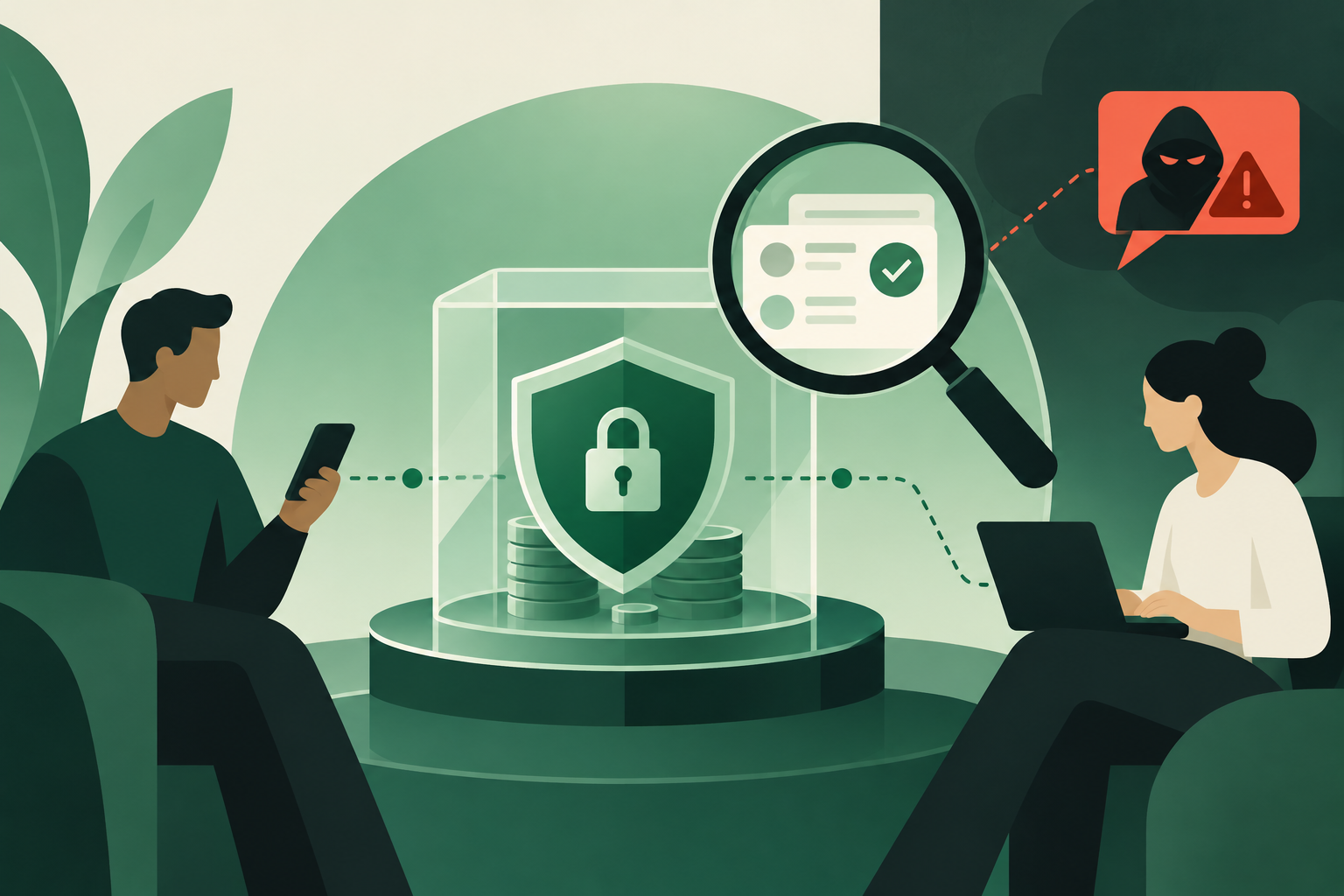
To avoid P2P crypto scams, keep the transaction inside the marketplace’s trade process, confirm that crypto is locked in escrow before paying, and never release crypto based on a screenshot or promise. Verify incoming money directly through your payment provider, reject unexplained payment-account changes, and protect your account with two-factor authentication. The key is to separate what the other trader claims from what you can independently verify.
Know what escrow protects—and what it does not
Escrow reduces the risk that a seller takes payment without delivering crypto. It holds the seller’s crypto during the transaction rather than leaving delivery entirely to their discretion.
On VouchEx, every trade is protected by escrow: the seller’s crypto is locked until they confirm they received payment. The marketplace supports USDT on TRC-20 and Bitcoin.
However, escrow does not make every payment safe. It cannot turn a fake receipt into real money, prevent you from sharing a password, or guarantee that a payment will never be reversed after crypto is released.
Think of security as three separate checks:
- Trade protection: Is the crypto actually locked in escrow?
- Payment verification: Has the correct payment reached the correct account?
- Account protection: Are you using the genuine website and keeping access credentials private?
A convincing chat message is not a substitute for any of these.
Common P2P scam patterns and their warning signs
Fake receipts and “pending” payments
A buyer sends a screenshot, email, or transaction reference and pressures the seller to release crypto. The evidence may be fabricated, or it may show a transfer that has only been scheduled.
Open your banking or payment app independently. Check the amount, currency, sender information where available, and transaction status. Do not use a link supplied by the buyer to “verify” the payment.
Stop if: The money is absent, pending, held, or only visible in the buyer’s evidence. Even an available balance does not eliminate every reversal risk; understand your provider’s rules before accepting that payment method.
Third-party payments and account substitutions
A trader says their friend, customer, or relative will pay. Alternatively, a seller asks you to send money to a different account after the trade begins.
These arrangements can obscure who actually authorized the payment. In a triangulation scam, a fraudster may direct another victim’s money to a crypto seller, then collect the crypto themselves.
Stop if: The payer’s identity or payment destination does not match the agreed arrangement. Treat “it’s my business partner” as an explanation to investigate, not proof that the payment is legitimate.
Off-platform deals and fake support
Someone offers a better price if you move to a messaging app, send crypto directly, or cancel the escrow-backed trade. Another version involves a supposed support agent requesting a password, authentication code, or transfer to a “safe wallet.”
Stop if: Completing the deal requires abandoning escrow or disclosing account secrets. Open support through the website yourself rather than trusting contact details supplied by the counterparty.
Overpayments, refund requests, and chargebacks
A buyer appears to overpay and asks you to refund the difference to another account. If the original payment is later reversed, you could lose both the refund and the crypto.
Other buyers may attempt to dispute or reverse a payment after receiving crypto. Different payment methods carry different reversal and unauthorized-payment risks.
Stop if: You are asked to send a separate refund, especially to a new destination. Contact the payment provider and marketplace support before moving more money.
How to avoid P2P crypto scams: a step-by-step checklist
Step 1: Secure your account before choosing an offer
Use a unique password and secure the email account connected to your marketplace account. Bookmark the genuine website so you do not need to rely on search ads or links sent in chat.
VouchEx offers optional authenticator-app 2FA for withdrawals and releases. Enable it before trading, and keep recovery information private. If you are getting started, use the official sign-up page.
Never share an authentication code or approve an action you did not initiate. A real-looking login page can still be a phishing page.
Step 2: Read the offer as a payment agreement
Before opening a trade, establish:
- Which asset and network you are trading.
- The exact amount and local currency to be paid.
- The payment method and recipient details.
- Any payment conditions that could delay completion.
- The trade fees and likely withdrawal costs.
When browsing the VouchEx marketplace, compare the whole offer rather than choosing solely by price. VouchEx supports hundreds of payment methods, including UPI, IMPS, bank transfer, PayPal, mobile money, and gift cards, across many local currencies. Availability is not a guarantee that every method has the same risk.
ID verification supports verified badges on VouchEx, but a badge is not a promise of honest behavior or irreversible payment.
Step 3: Check escrow and payment details before sending
As a buyer, confirm that the trade is active and the seller’s crypto is locked in escrow. Then check the payment destination against the details agreed for that trade.
Do not send payment merely because someone shares a wallet balance screenshot or says they have reserved the crypto privately.
VouchEx buyers have a 15-minute payment window. Have your payment method ready before starting. If you cannot complete payment within the window, seek guidance rather than sending a late payment into an uncertain trade state.
If details change unexpectedly, pause. Time pressure is a reason to be more careful, not less.
Step 4: Make one clear, traceable payment
Pay only the agreed amount using the agreed method. Avoid splitting payment across unrelated accounts or substituting another person’s account without resolving the implications first.
Keep the receipt and transaction reference. Record relevant communication in the marketplace’s trade process wherever possible, so the payment and the agreement can be reviewed together.
If money has left your account but the seller says it has not arrived, do not immediately pay again. Check the first transfer with your provider before risking a duplicate payment.
Step 5: Verify independently before releasing crypto
As a seller, open your payment account directly and inspect the actual transaction. Ask:
- Did the full agreed amount arrive in the right currency?
- Is it received rather than scheduled, pending, or held?
- Does the sender information fit the agreed payment arrangement?
- Are there unexpected deductions or restrictions?
- What reversal risks remain under this provider’s rules?
A familiar notification sound, SMS, email, or screenshot is insufficient. If something does not match, keep the crypto in escrow and seek help.
Do not release because the buyer is angry, claims an emergency, or says support instructed them to hurry you.
Step 6: Close only after your checks are complete
Buyers should not cancel a trade they have already paid merely because the seller promises to deliver outside the platform. Sellers should not release first in exchange for a promise that payment will follow.
Keep transaction records after completion because payment questions may arise later. Protect those records: do not publish full account numbers, identity documents, or authentication information when asking for help.
What to do if a trade looks suspicious
Stop taking irreversible actions. That means no crypto release, duplicate payment, separate refund, or transfer to a newly supplied wallet.
Then follow this sequence:
- Preserve evidence. Save the trade identifier, agreed terms, relevant messages, payment reference, amount, and timestamps.
- Check the payment directly. Use your provider’s official app or support channel to establish the transfer’s status.
- Use official marketplace support. Explain the mismatch factually and provide relevant evidence through the official channel.
- Secure your account if necessary. If you entered credentials on a suspicious site, change your password through the genuine website and secure your linked email.
- Contact your payment provider promptly if fraud is suspected. Ask what protective or recovery options are available; recovery is not guaranteed.
On VouchEx, disputes can be opened three hours after a trade starts. The person opening the dispute pays 1% of the trade, and moderators aim to resolve disputes within two hours. That is a target, not a guaranteed outcome or deadline.
Use the help page for guidance while preserving the trade’s evidence. The dispute waiting period is not a reason to release crypto you cannot verify payment for.
Budget for legitimate fees—not surprise demands
Knowing the published costs makes unexplained demands easier to question. VouchEx charges the buyer 1% and the seller 1% per completed trade. Deposits are free. Withdrawal fees are $2 for USDT and $5, paid in BTC, for Bitcoin.
A counterparty asking for an extra “verification deposit” or “unlock payment” should trigger a pause. Independently confirm any claimed platform charge through official information rather than paying an account supplied in chat.
The safest habit is simple: verify the trade, verify the payment, and only then authorize the irreversible action.
FAQ
Is P2P crypto trading safe if escrow is used?
Escrow reduces delivery risk by holding the seller’s crypto during the trade. It does not eliminate phishing, payment reversals, identity misuse, or mistakes when releasing crypto. Use escrow alongside independent payment verification and account security.
Can I trust a payment screenshot?
Not as proof of receipt. Screenshots can be edited or show an incomplete transfer. Sellers should inspect the transaction in their own payment account and understand any remaining restrictions or reversal risks.
What if the buyer pays from someone else’s account?
Pause before releasing crypto. A third-party payment can create uncertainty about authorization and ownership of the funds. Ask for official support guidance rather than accepting a personal explanation as sufficient proof.
What should I do if I paid but the seller asks me to cancel?
Do not cancel just to satisfy the seller’s request. Keep your payment evidence, avoid paying again, and seek support through the official marketplace channel. On VouchEx, a dispute can be opened three hours after the trade starts.
Does a verified badge mean a trader cannot scam me?
No. VouchEx uses ID verification for verified badges, but identity verification does not guarantee future behavior. Apply the same escrow, payment, and account-security checks regardless of a trader’s badge.
Start Trading on VouchEx with 0% Listing Fees
Explore the open P2P software protocol.