
How P2P Crypto Escrow Works: A Practical Trading Guide
P2P escrow locks the seller’s crypto while the buyer pays, then releases it after the seller confirms receipt. Learn the trade sequence, the checks that matter, and what to do when payment and release do not go as planned.
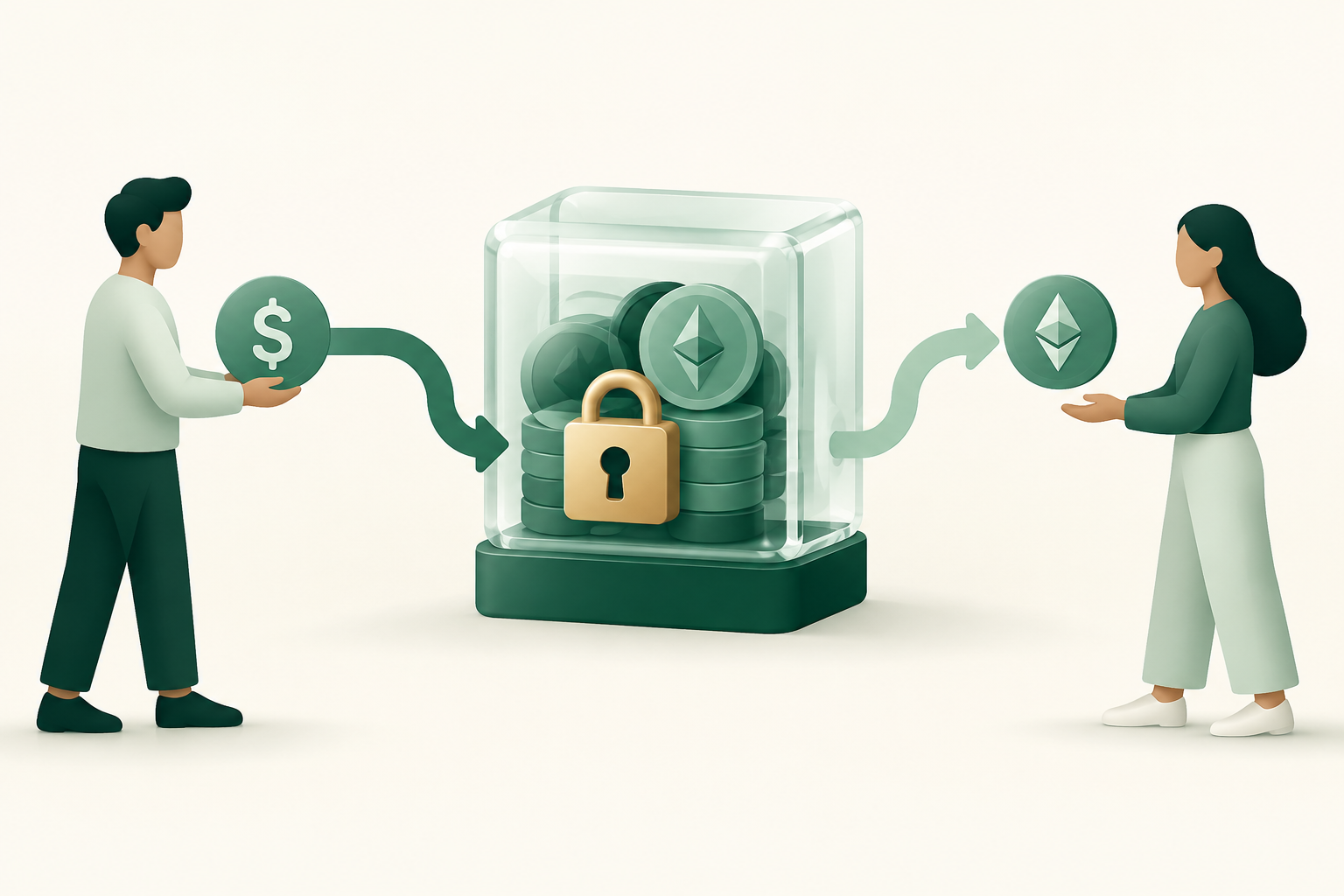
P2P crypto escrow works by locking the seller’s cryptocurrency while the buyer sends payment through an agreed payment method. The seller checks that the payment actually arrived, then confirms receipt so the crypto can be released to the buyer. On VouchEx, every trade uses this protection. Escrow reduces the risk of a seller taking payment while keeping control of the promised crypto, but it does not verify a bank transfer or make every payment irreversible.
Understanding that distinction is the key to trading safely: escrow protects the crypto during the exchange; both parties still need to verify the payment side.
What escrow holds—and what it does not
A peer-to-peer trade involves two separate movements of value:
- The crypto: supplied by the seller and locked in escrow for the trade.
- The payment: sent by the buyer using the agreed method, such as bank transfer or mobile money.
The buyer generally does not send their local-currency payment into the crypto escrow. They send it through the selected payment service according to the trade terms. The seller then checks receipt through that service.
VouchEx is a peer-to-peer marketplace for USDT on TRC-20 and Bitcoin. It supports hundreds of payment methods, including UPI, IMPS, bank transfer, PayPal, mobile money, and gift cards, across many local currencies.
Those methods do not all behave alike. A payment may be delayed, held, disputed, or reversed depending on the provider and circumstances. Escrow does not remove those differences.
Is crypto escrow always a smart contract?
No. “Escrow” describes a conditional holding arrangement, not one universal technical design. Platforms can implement it differently.
For a trader, the practical questions are whether the crypto is locked, what allows its release, and how problems are handled. Do not assume a service uses a particular smart contract, wallet structure, or custody model unless its documentation says so.
How P2P crypto escrow works, step by step
Step 1: Choose an offer you can actually complete
Before starting, check the asset, payment method, currency, price, trade limits, and seller’s terms. Make sure you can pay using the required method without needing to negotiate a different arrangement afterward.
On VouchEx, you can browse the marketplace offers to find a suitable trade.
Read for practical constraints, not just the advertised rate. Does your payment service have transfer limits? Could it hold a first-time payment? Can you complete the transfer within the payment window?
Step 2: Confirm the crypto is locked before paying
Start the trade through the platform and verify that the trade shows the seller’s crypto is held in escrow before sending payment.
Do not substitute a chat message, screenshot, or promise for the actual trade status. A message saying “I have reserved your coins” is not the same as a platform trade with escrow protection.
On VouchEx, the seller’s crypto is locked until they confirm they received payment. Keep the exchange within that protected trade rather than accepting an off-platform replacement deal.
Step 3: Pay using the agreed details and timing
Check the recipient information and amount against the trade instructions before authorizing the transfer. Stop and clarify unexpected changes, especially requests to pay a different recipient.
VouchEx buyers have a 15-minute payment window. Have your payment account ready before starting, and account for any authentication your bank or payment app requires.
Keep the receipt and transaction reference. If the platform asks you to indicate that payment was sent, do so only after you have actually sent it—not while you are still arranging funds.
Step 4: The seller independently checks receipt
The seller should open their own banking or payment app and check the transaction directly. A buyer’s screenshot, email, or SMS notification is supporting information, not conclusive proof of receipt.
Check:
- The amount and currency received.
- Whether the payment corresponds to this trade.
- Whether the funds are pending, held, or available.
- Any discrepancy in sender details that needs clarification.
Even an available balance does not necessarily eliminate later reversal risk. Sellers need to understand the rules of the payment method they accept.
Step 5: Release follows confirmed payment
Once the seller has verified receipt, they confirm it and the escrowed crypto can be released to the buyer.
Never release crypto just to let a buyer “finish” paying. That reverses the protective sequence. Once crypto leaves escrow, the escrow arrangement no longer holds those funds as protection for that trade.
Buyers should check the completed trade status and their crypto balance rather than relying only on the seller’s message that release is done.
Step 6: Preserve evidence if something goes wrong
If payment and release do not line up, keep the trade messages, payment reference, receipt, and relevant account transaction details. Describe the problem clearly: payment sent but not acknowledged, wrong amount received, or payment still pending.
Avoid sending a second payment simply because the first is not yet visible. First establish what happened to the original transfer.
Understanding VouchEx’s payment and dispute clocks
Two timing rules matter, and they serve different purposes:
- Buyers have 15 minutes to make payment.
- Disputes can be opened 3 hours after the trade starts.
The dispute threshold is not an extension of the payment window. Do not assume you can wait until the dispute becomes available before paying.
If a problem occurs earlier, preserve evidence, communicate within the trade, and consult the help resources. Do not guess what a timer means for cancellation, refund, or release. In particular, if you already paid, do not treat cancellation as a substitute for resolving that payment.
The person opening a VouchEx dispute pays 1% of the trade. Moderators aim to resolve disputes within 2 hours, but that is a target, not a guaranteed outcome or deadline.
What makes dispute evidence useful?
Useful evidence connects a specific payment to a specific trade. Preserve the transaction reference, amount, currency, recipient details, timestamp, and status where available.
Explain events in order and distinguish between what you know and what you suspect. “My payment app shows the transfer as completed” is more useful than an unsupported accusation.
Never share passwords, authenticator codes, private keys, or recovery phrases as evidence. Provide sensitive payment records only through the appropriate support process, and avoid exposing unrelated financial information.
What escrow protects against—and what remains risky
Escrow addresses the basic delivery problem: the seller should not retain freely available control of the promised crypto while expecting the buyer to pay first.
It does not make every offer, payment, or account interaction safe.
Fake payment confirmation
A screenshot can be altered, and a notification can be misleading. Sellers should verify receipt in their own payment account before releasing.
Reversible or disputed payments
Some payment methods allow disputes or reversals under certain conditions. Crypto escrow does not override a bank’s or payment provider’s rules after release.
Off-platform pressure
A counterparty may suggest another website, a private transfer, or an early release to “save time.” Keep the transaction within the agreed platform workflow. A separate transfer should not be assumed to have the original trade’s protection.
Account compromise
Escrow cannot replace account security. VouchEx offers optional authenticator-app 2FA for withdrawals and releases. Enable it to add protection around those sensitive actions.
VouchEx also offers ID verification for verified badges. A badge is a useful identity signal, not a guarantee that a payment is genuine or that a trade cannot go wrong.
Fees to understand before starting
VouchEx charges fees at different stages:
- Completed trade: 1% from the buyer and 1% from the seller.
- Deposits: free.
- USDT withdrawal: $2.
- Bitcoin withdrawal: $5, charged in BTC.
- Opening a dispute: 1% of the trade, paid by the opener.
Do not confuse a completed-trade fee with a withdrawal fee. Moving purchased crypto out of the platform is a separate action with a separate charge.
Compare the offer’s price alongside the applicable platform fees and any charges from your payment provider. A favorable-looking rate alone does not establish your total cost.
A quick pre-trade checklist
Before starting, ask yourself:
- Am I buying or selling the intended asset on the correct network?
- Do I understand the offer terms and payment method?
- Can I meet the payment window without rushing?
- Will I verify escrow status before paying, or actual receipt before releasing?
- Do I understand the fees and dispute timing?
- Have I enabled the available account protections?
If those answers are clear, you can create a VouchEx account and approach the trade with a plan rather than relying on reassurance from a stranger.
FAQ
Does escrow hold the buyer’s bank payment?
In the VouchEx trade flow described here, escrow locks the seller’s crypto. The buyer sends payment through the agreed payment method, and the seller independently verifies receipt before confirming release.
Can I pay before the trade shows escrow protection?
You should not. Verify the trade’s actual escrow status before sending money. A seller’s promise or screenshot is not a substitute for checking the protected trade on the platform.
What if I paid but the seller does not release the crypto?
Keep the payment receipt, transaction reference, and trade messages. Ask the seller to check receipt without sending another payment. On VouchEx, disputes become available 3 hours after the trade starts; the opener pays 1% of the trade.
Should a seller release crypto when shown a receipt?
Not on the receipt alone. Check the payment directly in your own account, including the amount and status. Understand the payment method’s reversal risks before deciding that it is appropriate to release.
Does escrow guarantee that a P2P trade is risk-free?
No. It protects the crypto during the exchange, but payment reversals, misleading evidence, account compromise, and off-platform transfers remain concerns. Use escrow together with careful payment verification, secure account access, and clear trade records.
Start Trading on VouchEx with 0% Listing Fees
Explore the open P2P software protocol.