
crypto affiliate program p2p: A Responsible Earning Guide
A P2P crypto affiliate program lets you earn a share of fees from people you refer. Learn how to evaluate the terms, explain trading risks, and build useful referral content without promising easy income.
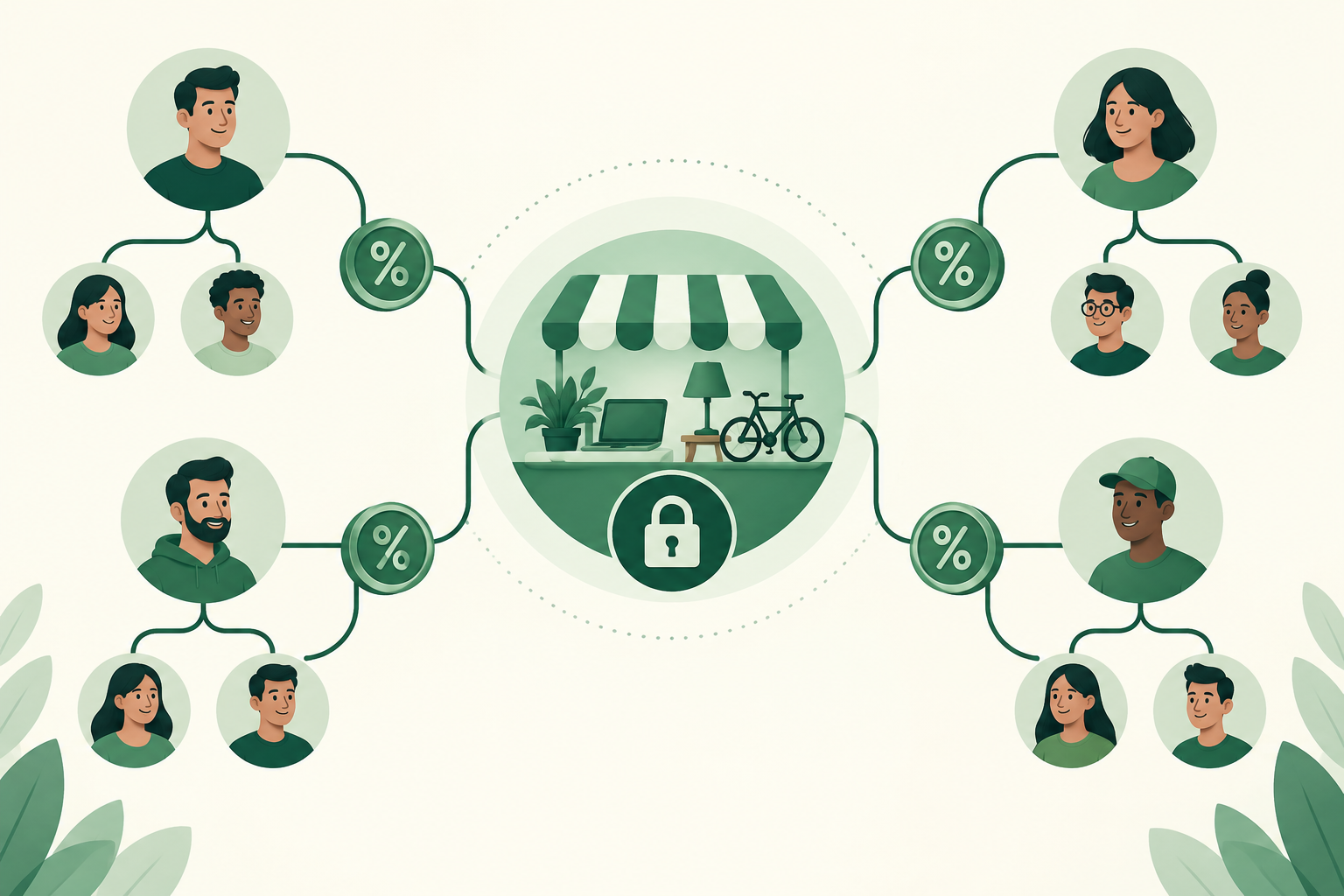
A crypto affiliate program for P2P trading lets you earn a share of platform fees generated by people you refer. VouchEx’s partner program offers 20% to 40% of the fees from your referrals. That is a share of fees—not a percentage of the crypto they buy or sell. Before promoting any program, check which fees qualify, how referrals are attributed, and when commissions become payable.
This guide explains how to evaluate the opportunity, introduce a peer-to-peer marketplace responsibly, and create referral content that helps people make informed decisions.
How a P2P crypto affiliate program works
In peer-to-peer trading, buyers and sellers transact with one another through a marketplace. An affiliate introduces potential users to that marketplace and may earn commission when their activity generates qualifying fees.
The affiliate’s role is different from the trader’s role:
- A buyer or seller participates in a trade and takes responsibility for payment, crypto release, and transaction costs.
- A merchant posts offers and manages trading activity.
- An affiliate helps people discover and understand the service, earning according to the partner program’s terms.
You can create useful affiliate content without presenting yourself as an experienced merchant. Equally, posting offers does not establish that you are enrolled in an affiliate program. Treat trading and referral participation as separate activities with separate requirements.
The most important distinction is between trade value, platform fees, and affiliate earnings. They are not interchangeable. A large trade does not mean an affiliate receives the advertised commission percentage of its full value.
What VouchEx offers—and what to verify
VouchEx is a peer-to-peer marketplace for USDT on TRC-20 and Bitcoin. Its partner program offers a share of referral-generated fees ranging from 20% to 40%.
Start with the VouchEx partner program to review the current terms. Do not assume the upper rate applies to every partner or every referred transaction.
Understand the commission base
A useful way to think about earnings is:
Affiliate commission = eligible referral fees × your applicable commission rate
The word eligible matters. VouchEx charges the buyer 1% and the seller 1% per completed trade, but those trading fees alone do not tell you exactly how an individual referral’s commission is calculated.
Before forecasting income, establish:
- Whether commission is based on the referred user’s fees or another defined fee base.
- Whether withdrawal fees are included or excluded.
- What determines your rate within the 20%–40% range.
- Whether any transactions or referral categories are excluded.
Until those details are confirmed, avoid advertising an estimated return per trade.
Check attribution and payment terms
An attractive percentage is only part of a useful affiliate program. You also need to understand how earnings are tracked and paid.
Ask whether existing users can qualify, how long referral attribution lasts, and what happens if someone follows more than one partner’s referral route. Confirm payout currency, timing, minimums, and any adjustments or reversals.
These are due-diligence questions, not claims about VouchEx’s features. If a detail is unclear, seek clarification through VouchEx help before putting it in promotional material.
Choose an audience you can genuinely help
The strongest referral content answers a specific trading question. “Join and earn” tells a prospective trader very little about whether a marketplace suits their needs.
More useful audience choices include:
- People comparing bank-transfer routes for buying USDT.
- Mobile-money users learning how P2P payment confirmation works.
- Bitcoin buyers who need a clear explanation of escrow.
- Prospective merchants comparing offer-posting requirements and costs.
VouchEx supports hundreds of payment methods, including UPI, IMPS, bank transfer, PayPal, mobile money, and gift cards, across many local currencies. However, marketplace-level support does not guarantee that a suitable offer is available whenever a reader visits.
Encourage readers to inspect the current marketplace offers, including payment method, price, limits, and seller instructions. Do not promise universal availability or describe every payment method as equally safe.
Explain the product honestly before sharing a referral
Your audience should understand both the service and its practical limitations. A useful introduction covers the following areas.
Escrow and payment confirmation
Every VouchEx trade is protected by escrow: the seller’s crypto is locked until the seller confirms receipt of payment.
Escrow helps control crypto release, but it does not make every payment risk disappear. A screenshot or message is not a substitute for checking the receiving account. Some payment methods can also involve reversal or chargeback risk after an apparent payment.
Avoid describing escrow as a guarantee against every kind of fraud or loss.
Costs beyond the advertised trade price
VouchEx charges 1% to the buyer and 1% to the seller per completed trade. Deposits are free. Withdrawal fees are $2 for USDT and $5, charged in BTC, for Bitcoin.
Readers should compare the offer price, their applicable trading fee, and any withdrawal cost. Payment-provider or currency-conversion charges may also apply outside the marketplace.
Be particularly clear that free deposits do not mean fee-free trading. Likewise, posting buy or sell offers is free and requires no merchant deposit, but completed trades still carry fees.
Timing and account protection
Buyers have a 15-minute payment window. They should prepare their payment method before starting and follow the trade instructions carefully.
Disputes can be opened 3 hours after a trade starts. The opener pays 1% of the trade, and moderators aim to resolve disputes within 2 hours. Present that resolution period as an aim, not a guaranteed deadline.
VouchEx offers optional authenticator-app 2FA to protect withdrawals and releases. ID verification is used for verified badges. Neither feature should be presented as proof that a counterparty is risk-free.
Step by step: Build a responsible referral workflow
Step 1: Verify the program before publishing
Review the partner terms and record the rules affecting attribution, eligible fees, commission rates, and payment. Use only the referral method the program provides or confirms; do not assume an ordinary website link tracks referrals.
Check any restrictions on paid advertising, brand keywords, incentives, or self-referrals. If a policy is not clear, ask rather than guessing.
Step 2: Pick one real user problem
Choose a narrow question you can answer accurately, such as how to compare a USDT bank-transfer offer or what to check before releasing Bitcoin.
Build the guide around that task. Explain when the service might fit and when the reader should pause—for example, when they cannot meet the payment window or do not understand an offer’s instructions.
Step 3: Publish the explanation before the pitch
Show readers what to inspect: supported asset and network, payment method, offer price, limits, fees, and trade terms.
Keep the referral invitation secondary to the answer. Readers who decide not to trade should still leave with useful knowledge.
Avoid guaranteed-income claims, invented user testimonials, or claims that a particular offer is always cheapest.
Step 4: Disclose the affiliate relationship
Place a clear disclosure near the recommendation or referral link. For example:
Disclosure: I may earn a share of platform fees if you join through my referral and make qualifying trades.
Adapt the wording to the confirmed program terms and applicable advertising rules. Do not claim the referral changes—or does not change—the reader’s costs unless that has been verified.
Step 5: Keep onboarding separate from custody
Direct readers to the official website and the confirmed referral route. The ordinary VouchEx sign-up page is an account entry point, but you should not assume that an untracked sign-up will be attributed to you.
Never ask someone to send you trading funds, passwords, authentication codes, or wallet recovery phrases. Help them understand the process without taking control of their account.
Step 6: Review outcomes and update the guide
Use whatever reporting the program actually provides to distinguish visits, attributed users, qualifying activity, and payable commission.
Do not treat clicks as income or projected commission as money received. Review whether your content attracts people whose needs match the marketplace, and update explanations when confirmed terms change.
Judge the opportunity by fit, not just percentage
A higher commission rate is not automatically a better opportunity. Audience relevance, understandable terms, usable payment methods, and accurate educational content all matter.
Your own costs matter too. Writing, translation, video production, and advertising can consume time or money before any commission becomes payable. Avoid committing to paid promotion based only on the headline rate.
The practical test is simple: Would this guide still help the reader if the referral link were removed? If the answer is yes, you are building something more useful than a sales pitch—and giving readers a sounder basis for deciding whether to trade.
FAQ
What does “crypto affiliate program p2p” mean?
It refers to a referral program associated with a peer-to-peer crypto marketplace. Affiliates introduce users and earn according to the program’s rules, commonly through a share of qualifying platform fees rather than a share of the full trade value.
How much does the VouchEx partner program pay?
VouchEx offers 20% to 40% of the fees from people you refer. Confirm your applicable rate, eligible fee categories, attribution rules, and payment conditions before estimating earnings. The advertised range does not establish which rate you will receive.
Do I need to become a merchant to be an affiliate?
Merchant trading and affiliate referrals are different activities. Do not assume that permission to post offers also establishes partner eligibility. Check the partner program’s enrollment requirements separately from the marketplace’s trading rules.
Does escrow make referred users’ trades risk-free?
No. Escrow locks the seller’s crypto until payment is confirmed, but users still need to check payment carefully, follow trade terms, and account for payment-method risks. Affiliates should explain these responsibilities rather than promise completely safe trades.
Can I promise passive or guaranteed income?
No. A commission rate does not guarantee referrals, qualifying trading activity, or payable earnings. Describe the opportunity as conditional fee-sharing, disclose your relationship, and avoid encouraging unnecessary trading simply to generate commissions.
Start Trading on VouchEx with 0% Listing Fees
Explore the open P2P software protocol.