
Binance P2P alternative: Is VouchEx a Practical Switch?
VouchEx is an option for peer-to-peer USDT and Bitcoin trading, but the right choice depends on more than payment methods. Compare total costs, escrow limits, dispute timing, and merchant requirements before switching.
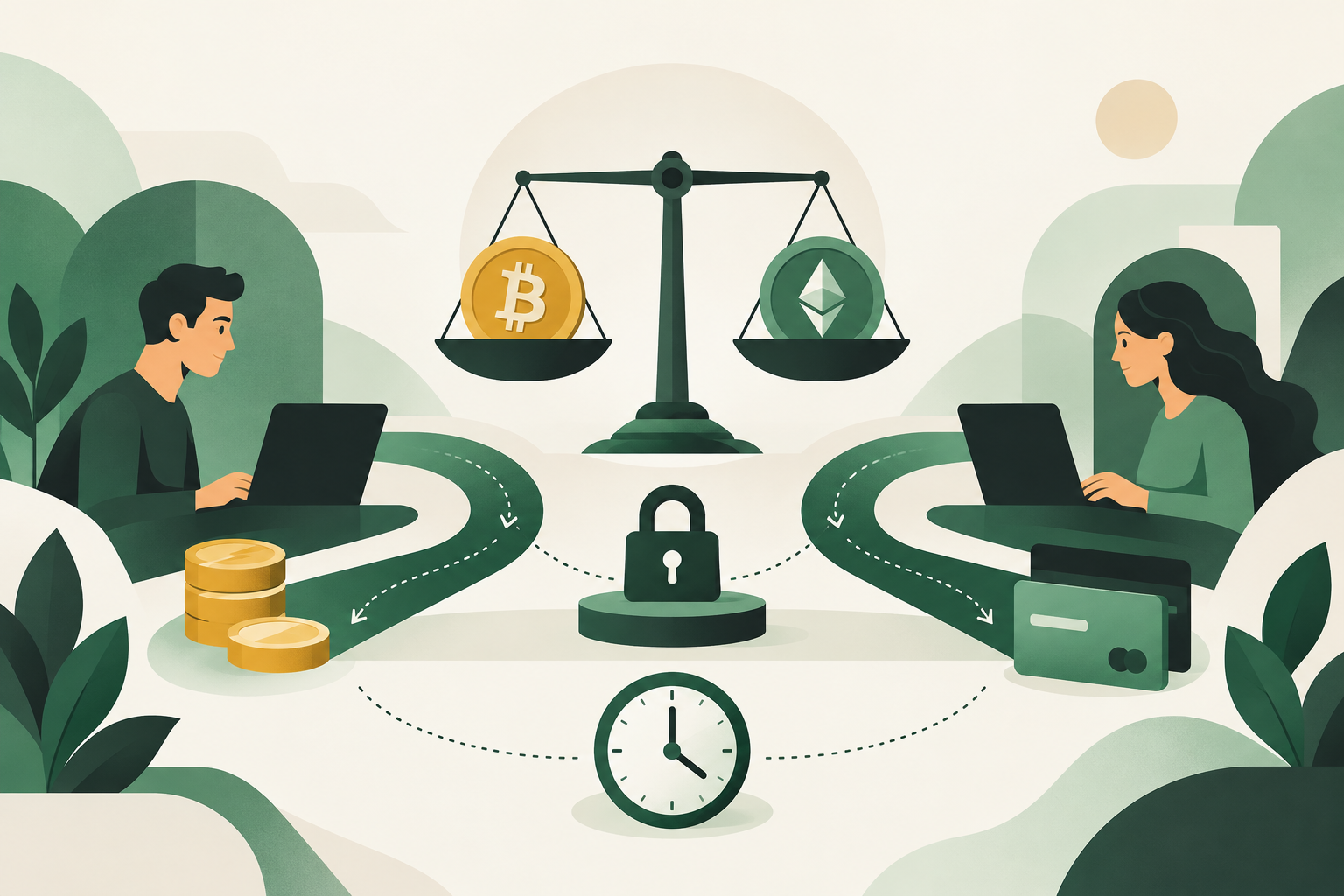
VouchEx is a Binance P2P alternative worth considering if you want to buy or sell USDT on TRC-20 or Bitcoin using local payment methods, with escrow on every trade. Whether it is a better fit depends on the offers available to you, the total cost, and whether its payment and dispute timelines suit your needs—not simply whether it lists your preferred payment method.
This guide compares the decisions that matter before switching. VouchEx’s rules are set out below; for Binance P2P, check the current terms applicable to your account, location, and intended transaction rather than relying on old fee comparisons.
Start with the reason you want an alternative
A replacement only helps if it fixes the problem you actually have. Someone seeking a different payment method needs a different comparison from a merchant looking to post offers.
Identify your main requirement:
- Payment access: You need an offer that accepts your specific bank, wallet, or local payment method.
- Better value: You want more crypto for the same payment, after all relevant charges.
- Clearer trade rules: You want to understand when payment is due and when a dispute can begin.
- Merchant access: You want to post offers and can meet the marketplace’s requirements.
- Asset compatibility: You need Bitcoin or specifically USDT on the TRC-20 network.
If your reason for leaving Binance involves regional eligibility or account restrictions, confirm that any replacement can legitimately serve you. A different marketplace is not automatically a solution to local access requirements.
VouchEx and Binance P2P: what to compare
The table separates known VouchEx terms from the checks you should make on Binance P2P. It does not assume that Binance’s fees, access, or payment options are identical across accounts and markets.
| Comparison point | VouchEx | What to check on Binance P2P |
|---|---|---|
| Assets | USDT on TRC-20 and Bitcoin | Whether your intended asset and withdrawal network are available |
| Completed-trade fees | Buyer pays 1%; seller pays 1% | Current charges for your role and transaction |
| Deposits and withdrawals | Free deposits; USDT withdrawal fee of $2; Bitcoin withdrawal fee of $5, paid in BTC | Deposit and withdrawal costs for the same asset and network |
| Escrow | Seller’s crypto is locked until they confirm payment was received | Current escrow and release procedures |
| Payment timing | Buyer has a 15-minute payment window | The payment deadline on the selected offer |
| Disputes | Can be opened 3 hours after the trade starts; opener pays 1% of the trade | Eligibility, timing, evidence requirements, and any charges |
| Posting offers | Merchants lock a refundable $200 USDT deposit | Current advertiser eligibility and any deposit requirements |
Use the table as a checklist, not a ranking. A platform with suitable published terms may still lack a matching offer when you need to trade.
Compare the final outcome, not just the fee label
VouchEx charges each side separately: 1% from the buyer and 1% from the seller per completed trade. Deposits are free. Withdrawals cost $2 for USDT or $5 in BTC for Bitcoin.
Those charges are only part of the comparison. The exchange rate in an offer also affects what you receive, and a payment provider may impose its own charges.
If you are buying
Compare the same payment amount, currency, asset, and payment method on each marketplace. Then check:
- The amount of crypto quoted in the offer.
- How the buyer fee affects the final amount you pay or receive.
- Any bank or payment-provider charge.
- The withdrawal fee, if you intend to move the crypto out.
Confirm how fees appear in the trade interface rather than assuming they are included in the advertised rate. A separate withdrawal charge also matters more when it represents a larger share of your purchase.
If you are selling
Compare your local-currency proceeds against the crypto you must commit, including the seller fee. Also consider the payment method’s rules, settlement status, and potential for reversal.
A higher advertised price is not necessarily the better deal if the payment conditions introduce risks you cannot comfortably manage.
If a dispute becomes necessary on VouchEx, the opener pays an additional 1% of the trade. Treat that as a possible dispute-related cost, not a routine charge on every transaction.
Payment variety is useful only when an offer matches
VouchEx supports hundreds of payment methods across many local currencies, including UPI, IMPS, bank transfer, PayPal, mobile money, and gift cards.
That variety does not mean every method has a suitable offer for every amount at every moment. Before choosing a marketplace, inspect actual listings in the VouchEx marketplace and compare them with your available Binance P2P offers.
Look beyond the payment-method label:
- Does the offer accept your intended trade amount?
- Is the payment currency correct?
- Can you meet the stated payment instructions?
- Are the counterparty’s terms understandable and acceptable?
- Can you complete the payment within the deadline?
Do not assume different payment methods carry the same risk. Bank transfers, payment wallets, and gift cards have different documentation and dispute processes. Use a method you understand, not merely the offer with the most attractive rate.
Escrow helps, but payment verification still matters
Every VouchEx trade uses escrow: the seller’s crypto is locked until the seller confirms receipt of payment. This creates a controlled release process, but it does not make every payment claim genuine or every payment irreversible.
For sellers, the critical check happens in the receiving account. A screenshot, email, or message saying “paid” is not a substitute for checking the actual transaction and understanding its status.
For buyers, keep payment tied to the active trade and its instructions. If someone asks you to cancel the trade and pay privately, you would be moving away from the escrow-backed process.
Use account protections deliberately
VouchEx offers optional authenticator-app 2FA to protect withdrawals and releases. Enable it before trading, and keep recovery information secure.
ID verification is used for verified badges. A badge is useful context, but it is not a guarantee that a counterparty’s payment is safe or that their instructions should override marketplace rules.
Know the timing before committing money
VouchEx has separate payment and dispute timelines:
- Buyers have 15 minutes to make payment.
- A dispute can be opened 3 hours after the trade starts.
- The person opening the dispute pays 1% of the trade.
- Moderators aim to resolve disputes within 2 hours.
The resolution target is an aim, not a guaranteed deadline. Also, the payment window and dispute eligibility point serve different purposes: do not expect a dispute to become available immediately when the payment window ends.
Before starting, consider whether your payment method can realistically work within the available time. If payment is delayed or a transfer’s status is unclear, avoid sending a duplicate simply to satisfy pressure from the counterparty. Keep the records and consult the help resources for guidance.
How to evaluate an alternative step by step
1. Define one specific trade
Write down the asset, network, local currency, payment method, and amount you want to use. Comparing unlike transactions produces misleading results.
For USDT, confirm that your receiving wallet supports TRC-20 if you plan to withdraw. Do not assume that every USDT address uses the same network.
2. Compare live offers side by side
Check offers close together in time, since prices and availability can change. Read the full terms rather than comparing only the headline rate.
If no offer matches your needs, stop there. A long payment-method list cannot replace an executable trade.
3. Check the total cost and trade rules
Include the applicable trade fee, any payment-provider charge, and a withdrawal fee if relevant. Confirm the payment deadline and the dispute process before accepting the offer.
For VouchEx, make sure you are comfortable with both the dispute waiting period and the opener’s fee.
4. Secure the account and prepare evidence
Enable available security protections. Keep trade communications in the marketplace where possible, and retain the payment reference, receipt, amount, currency, and time.
Never provide passwords, authenticator codes, or wallet recovery phrases to a counterparty.
5. Start with a manageable transaction
Choose an amount within the offer limits that you can afford to have tied up if a problem occurs. Follow the payment instructions carefully, and verify receipt before releasing crypto when selling.
Afterward, assess the actual cost, clarity of instructions, and practical payment experience before committing to larger activity.
Is VouchEx suitable for merchants?
To post offers, VouchEx merchants lock a refundable $200 USDT deposit. The refund follows a 7-day wait, with no open disputes.
This is a capital commitment, not the same thing as a completed-trade fee. Consider whether you can leave those funds locked while also funding trades and managing payment delays.
Review the merchant requirements before deciding. VouchEx is a plausible fit when its supported assets, matching offers, fees, and operating rules work for you. Staying with your current marketplace may be more practical when it already meets those needs at a better overall cost.
FAQ
Is VouchEx a Binance P2P alternative?
Yes. VouchEx offers peer-to-peer buying and selling of USDT on TRC-20 and Bitcoin, with escrow on every trade. Its suitability depends on matching offers, payment access, total cost, and the trade rules you need.
Is VouchEx cheaper than Binance P2P?
Not necessarily. Compare current offers and applicable charges for the same transaction. VouchEx charges buyers and sellers 1% each per completed trade, plus a withdrawal fee if funds are withdrawn. The offered exchange rate also affects value.
Can I use UPI, PayPal, or mobile money?
VouchEx supports these methods, alongside IMPS, bank transfer, gift cards, and others. You still need an available offer matching your method, currency, amount, and acceptable terms.
Does escrow eliminate payment risk?
No. Escrow locks the seller’s crypto pending confirmation of payment, but it does not eliminate fake payment evidence or risks associated with a payment method. Sellers should verify receipt directly before releasing crypto.
What if a VouchEx trade goes wrong?
A dispute can be opened 3 hours after the trade starts. The opener pays 1% of the trade, and moderators aim to resolve disputes within 2 hours. Preserve the trade conversation and payment records; the resolution target is not a guarantee.
Start Trading on VouchEx with 0% Listing Fees
Explore the open P2P software protocol.