
Best P2P Crypto Exchange: Compare What Actually Matters
The best P2P crypto exchange depends on your payment method, total cost, and the protection available when a trade goes wrong. Use this practical framework to compare marketplaces and decide whether VouchEx fits your needs.
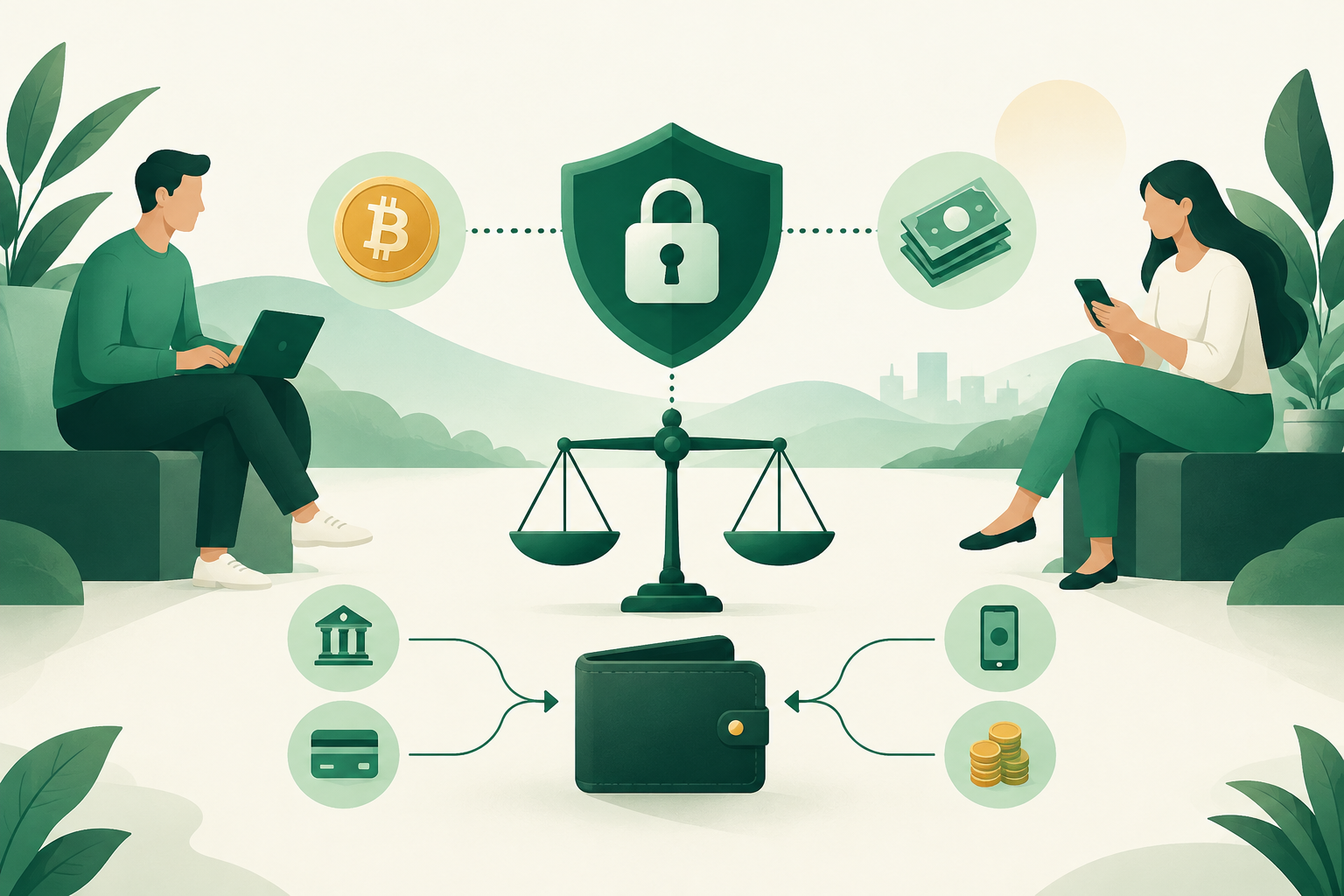
The best P2P crypto exchange is the one that has a suitable offer for your payment method, a competitive total cost, and trade rules you understand before sending money. VouchEx is worth considering for USDT on TRC-20 and Bitcoin, with escrow on every trade and a published fee structure. It is not automatically the best choice for every buyer or seller: compare the actual offers, payment restrictions, and dispute process against your alternatives.
A useful comparison goes beyond the fee on a pricing page. This guide shows you how to evaluate a marketplace, where VouchEx fits, and how to check your first trade without mistaking convenience for safety.
Start with the trade you actually need
A peer-to-peer marketplace connects people buying and selling crypto. The payment between them typically happens through an agreed payment method, while the marketplace manages the crypto side through its trade process.
That means you are evaluating two things: the platform and the individual offer. A platform can support your preferred payment method without having a suitable offer available when you need it.
Before comparing exchanges, write down:
- Asset and network: Bitcoin, or USDT on a specific network?
- Payment method and currency: What can you actually use to pay or receive money?
- Trade amount: Does it fit the offer's minimum and maximum?
- Destination: Will you keep the crypto on the platform or withdraw it?
- Timing: Can you complete payment within the required window?
These requirements narrow the search more effectively than a generic ranking. If you need USDT on a network other than TRC-20, for example, VouchEx's stated USDT support does not match that requirement.
A practical comparison: where VouchEx fits
Use this table as a comparison worksheet. For another marketplace, fill in each answer from its current terms and live offers rather than assuming all P2P platforms work alike.
| Comparison point | VouchEx | What to check elsewhere |
|---|---|---|
| Supported crypto | USDT on TRC-20 and Bitcoin | Exact asset and network support |
| Escrow | Seller's crypto is locked until they confirm payment received | When escrow starts and what triggers release |
| Trading fees | Buyer pays 1%; seller pays 1% per completed trade | Fees for your side of the transaction |
| Deposits and withdrawals | Deposits free; USDT withdrawal $2; Bitcoin withdrawal $5 in BTC | Withdrawal charges as well as trading fees |
| Payment choices | Hundreds of methods in many local currencies | Suitable live offers, limits, and restrictions |
| Payment deadline | Buyer has 15 minutes | Whether your payment route fits the deadline |
| Disputes | Can open after 3 hours; opener pays 1% of the trade | Waiting period, filing cost, and evidence requirements |
| Account protection | Optional authenticator-app 2FA protects withdrawals and releases | Which sensitive actions 2FA covers |
| Merchant access | Refundable $200 USDT deposit required to post offers | Capital requirements and refund conditions |
For historical comparisons, remember that Paxful closed its marketplace in 2025. It should not appear as an active trading option in a current shortlist. If you are considering NoOnes or another alternative, check its current published rules and available offers directly; do not assume that familiar branding means identical costs or protections.
Compare total cost, not just the trading fee
The cheapest advertised fee does not necessarily produce the cheapest purchase. An offer's exchange rate can matter more than a small difference in platform fees.
For a buyer, compare:
- The amount of local currency you will pay.
- The crypto amount shown in the offer.
- Any buyer-side trading fee.
- Any payment-provider or currency-conversion charge.
- The withdrawal fee, if you plan to move the crypto.
A useful final measure is total local currency spent divided by crypto received in your intended destination. Use the same asset, payment method, trade size, and destination when comparing offers. Check whether the displayed quote already includes fees so you do not count them twice.
What VouchEx's fees mean in practice
VouchEx charges 1% to the buyer and 1% to the seller for each completed trade. Those are separate charges to the two participants, not a 2% platform charge imposed entirely on the buyer.
As a simple hypothetical calculation, a trade valued at $100 carries a $1 fee for each side. A buyer who then makes one USDT withdrawal also faces the published $2 withdrawal fee. That is $3 in the buyer's listed platform charges, before considering the offer's exchange rate or any external payment costs.
For Bitcoin, the withdrawal charge is $5 paid in BTC. Deposits are free.
Fixed withdrawal charges have a larger proportional effect on smaller transactions. Compare the whole transaction, but do not increase your trade size beyond your comfort level merely to dilute a fee.
Escrow matters, but so do release and dispute rules
On VouchEx, every trade uses escrow: the seller's crypto is locked until the seller confirms that payment has been received.
That protects the crypto while the trade is underway. It does not turn every payment method into an irreversible payment or guarantee that every counterparty will behave honestly.
For buyers: keep payment tied to the trade
Before paying, confirm that the trade is active and the crypto is in escrow. Follow the agreed payment instructions, and retain the transaction reference and receipt.
Do not accept a request to bypass the platform's trade process. If payment has already been sent and a problem arises, preserve your evidence and consult the platform's instructions rather than improvising a second payment.
For sellers: verify receipt independently
Check your own bank or payment account before releasing crypto. A screenshot, email, or message from the buyer is not a substitute for confirming receipt yourself.
Different payment methods carry different reversal and fraud risks. Understand those risks before accepting a method, especially when the payment provider may allow disputes or chargebacks after an apparent receipt.
Know the dispute timeline before you need it
On VouchEx, disputes can be opened 3 hours after a trade starts. The person opening the dispute pays 1% of the trade, and moderators aim to resolve disputes within 2 hours.
That resolution time is a target, not a guarantee. The payment window, dispute-opening wait, and resolution target are separate parts of the process. If you need immediate access to funds, consider whether those rules fit your situation.
Review the help resources before trading, particularly if you are unsure what evidence to retain.
Payment choice and trust signals need a closer look
VouchEx supports hundreds of payment methods, including UPI, IMPS, bank transfer, PayPal, mobile money, and gift cards, across many local currencies.
Broad support is useful, but it is not a promise of an available offer for every combination of currency, method, and amount. Browse the marketplace to check what matches your needs.
Read each offer's terms carefully. Look for payment instructions you can follow without misrepresenting the transaction or breaking your payment provider's rules. Skip offers that introduce unexplained payments, pressure you to hurry, or ask you to move the transaction outside the platform.
VouchEx offers ID verification for verified badges. Treat a badge as an identity-related signal, not a guarantee of honest behavior or a reason to skip payment checks.
Optional authenticator-app 2FA protects withdrawals and releases. Enabling it adds a useful account-security layer, but it does not replace careful counterparty and payment verification.
How to compare and complete your first trade
1. Define a like-for-like comparison
Choose the asset, network, currency, payment method, and amount. Decide whether a withdrawal is part of your plan. Compare marketplaces using those same requirements.
2. Shortlist offers you can actually use
Check limits and payment conditions before focusing on price. An attractive rate is irrelevant if you cannot meet the terms or complete payment on time.
3. Calculate the full cost
Compare the quoted crypto amount and all applicable charges. For VouchEx, include your side's 1% completed-trade fee and the withdrawal charge if applicable. Account for external payment costs separately.
4. Secure your account and prepare evidence
Enable available security protections. Know how to save payment receipts and transaction references, and read the dispute rules before money moves.
5. Start only when ready to pay
VouchEx buyers have a 15-minute payment window. Have your payment account ready before starting. Do not assume a slow transfer method will fit simply because it is listed.
Confirm escrow before sending payment, then follow the trade instructions. Never indicate that you have paid unless you actually have.
6. Verify completion and withdrawal details
Sellers should confirm receipt in their own payment account before release. Buyers planning to withdraw should verify the destination address and compatible network carefully. For VouchEx USDT withdrawals, the receiving destination must support TRC-20.
Buyers and merchants may choose differently
For an occasional buyer, the deciding factors may be payment convenience, the final purchase cost, and a manageable first trade.
For a merchant, compare the cost of both trading and keeping capital committed. VouchEx merchants lock a refundable $200 USDT deposit to post offers. Refunds require a 7-day wait and no open disputes.
The deposit is not the same as a per-trade fee, but it affects available capital. Review the merchant requirements alongside the seller's 1% completed-trade fee before deciding whether posting offers suits your activity.
The practical verdict: shortlist VouchEx if you want Bitcoin or TRC-20 USDT and its available offers, fees, and timing rules match your needs. Choose based on the transaction you can complete safely—not the platform with the strongest “best exchange” claim.
FAQ
What is the best P2P crypto exchange for beginners?
Look for clear escrow rules, understandable fees, a familiar payment method, and accessible dispute instructions. VouchEx is a candidate for Bitcoin and TRC-20 USDT, but inspect a suitable offer before deciding.
Is VouchEx free to use for P2P trading?
Deposits are free, but completed trades cost 1% for the buyer and 1% for the seller. Withdrawals cost $2 for USDT or $5 in BTC for Bitcoin. Opening a dispute costs the opener 1% of the trade.
Does escrow make a P2P exchange completely safe?
No. Escrow protects crypto during the trade, but account compromise, misleading payment evidence, and payment reversals remain relevant risks. Verify payment independently and keep the transaction within the platform's process.
Can I buy USDT on VouchEx with UPI or PayPal?
VouchEx supports UPI and PayPal among its payment methods. Whether you can complete a particular purchase depends on finding an available offer with suitable currency, limits, and terms. Its supported USDT network is TRC-20.
How quickly can a VouchEx dispute be resolved?
A dispute can be opened 3 hours after the trade starts. Moderators aim to resolve disputes within 2 hours, but that is not a guaranteed completion time. Keep payment evidence available to support review.
Start Trading on VouchEx with 0% Listing Fees
Explore the open P2P software protocol.